[ad_1]

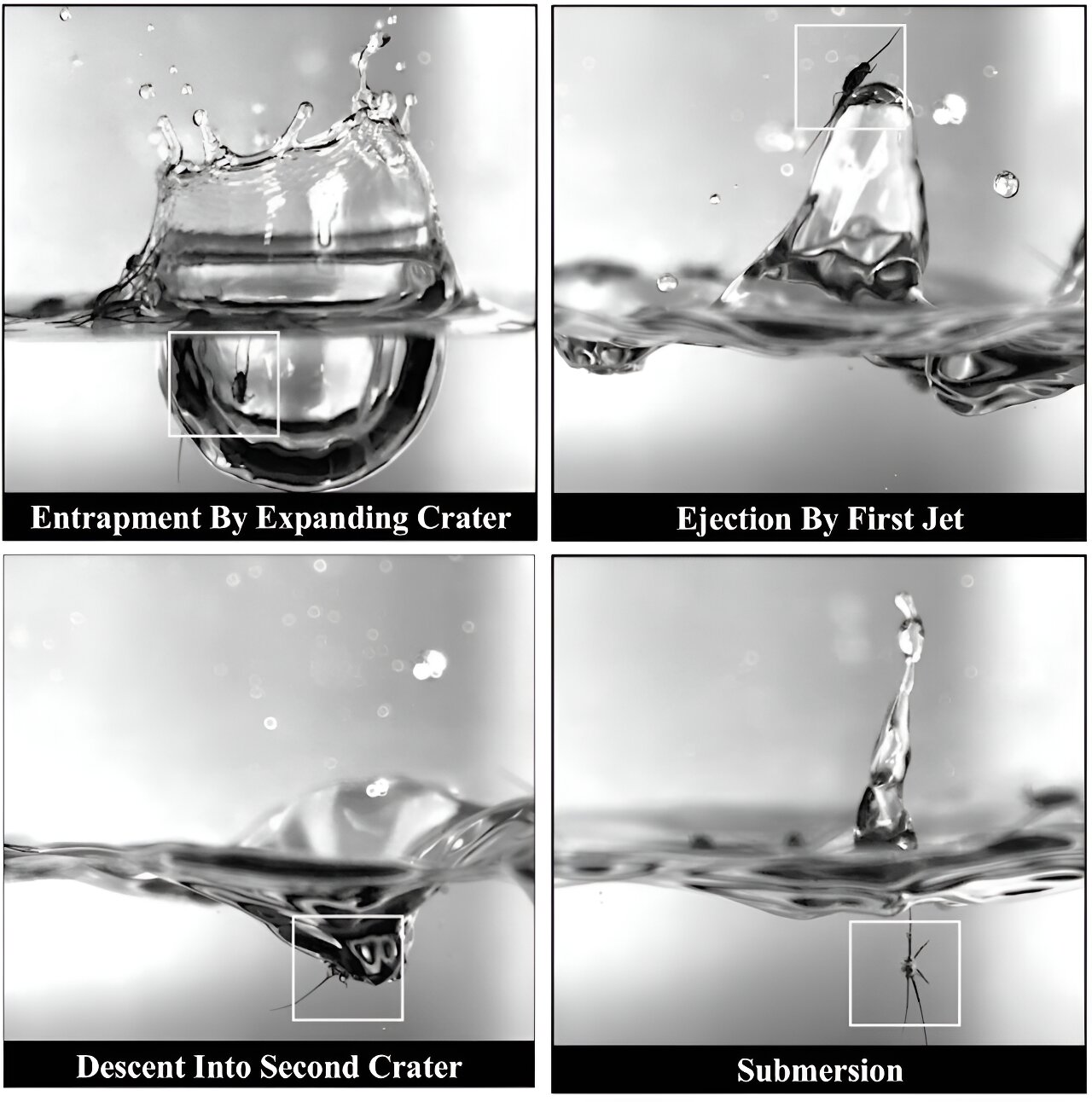
Raindrops form two craters, the second of which can submerge striders. Credit: Proceedings of the National Academy of Sciences (2024). DOI: 10.1073/pnas.2315667121
Microplastics are tiny particles of plastic that can cause big problems when they get into the water supply. In one approach, my fluid dynamics lab explores the movement of microplastics by studying how tiny water-walking insects are pushed underwater by raindrops.
Exposure to microplastic pollution can lead to health risks such as respiratory and digestive problems, increased risk of diabetes and disrupted sleep. But physicists like me can study how they move through water to learn how to clean them up.
Water striders are small insects that can walk on water. They are abundant in wet, rainy areas, and some species spend their entire lives without ever touching land. Raindrops can weigh more than 40 times as much as a water strider, and during rainstorms they occasionally hit striders directly. The drops form a tiny crater below the water’s surface that engulfs the strider before launching it back out as the crater collapses at the surface.
Water striders have strong exoskeletons that allow them to survive being hit by a raindrop. Because these insects are water-repellent and very light, they usually bounce back. But sometimes the raindrops will form a second, smaller crater just beneath the surface. The second crater usually forms from a large, fast drop.
If the water strider ends up inside this second crater, it can become trapped underwater.
In my lab’s latest study, published in Proceedings of the National Academy of Sciences, we caught water striders from local ponds and released drops that fell onto their tanks. We used high-speed videography and image analysis to see how quickly the insects submerged when raindrops hit them.
My colleagues and I also measured the acceleration of the second, smaller crater. This crater retracts quickly: according to our measurements, at 50 times the acceleration due to gravity. Water striders cannot hold themselves up inside this second bubble, since the surface they are standing on moves upward very quickly, and they can fall underwater and be submerged. If this happens, the water striders make powerful swimming strokes to try to resurface.
Like water striders, microplastics are very light and often water-repellent. They tend to move across the water in a similar way, and raindrops can submerge them. When pollutants become submerged, they are harder to clean up, and marine life may consume them.
Our research tells us that the rapid acceleration of the second crater toward the water’s surface plays an important role in sinking tiny particles, both water striders and microplastics.
Studying how small particles and organisms disperse in water could help scientists understand how to prevent and mitigate microplastic pollution.

Striders can often kick back up to the surface if they get submerged, unlike plastic particles. Credit: Proceedings of the National Academy of Sciences (2024). DOI: 10.1073/pnas.2315667121
Water striders are so water-repellent that they carry a bubble around them, called a plastron, when pushed underwater.
In the lab, the more times they are hit by drops before shedding the water, the more likely water striders are to stay submerged for extended periods.
Raindrop impacts seem to deplete the plastron. We don’t yet know how many repeated impacts striders can tolerate, or how chemical pollutants in waterways affect their resistance to submersion.
Future work will replace the water striders in our experiments with floating particles that mimic microplastics, across a range of sizes, densities and water repellency. We expect larger particles to make the drops break apart on contact, while smaller particles will likely be carried into the air, or aerosolized, by the splash.
And striders aren’t just good models for microplastic movement. Studying water striders’ legs as they swim could also help researchers design underwater robots.
More information:
Daren A. Watson et al, Water striders are impervious to raindrop collision forces and are submerged by crater collapse, Proceedings of the National Academy of Sciences (2024). DOI: 10.1073/pnas.2315667121
Provided by
The Conversation
This article is republished from The Conversation under a Creative Commons license. Read the original article.
Citation: Tiny water-walking bugs provide scientists with insights on how microplastics are pushed underwater (2024, January 23) retrieved 23 January 2024 from https://phys.org/news/2024-01-tiny-bugs-scientists-insights-microplastics .html
This document is subject to copyright. Apart from any fair dealing for the purpose of private study or research, no part may be reproduced without the written permission. The content is provided for information purposes only.
[ad_2]
Source link