

Imagine holding a single piece of paper in your hands. You fold it one way and it becomes a crane. You smooth it flat, fold it another way, and it becomes a boat. Same paper, same material, two entirely different objects. Now multiply that idea by a factor of over 100,000, shrink it down to the nanoscale, and set it inside the nucleus of every cell in your body. That is roughly what is happening right now with G-quadruplexes.
A Structure That Refuses to Sit Still
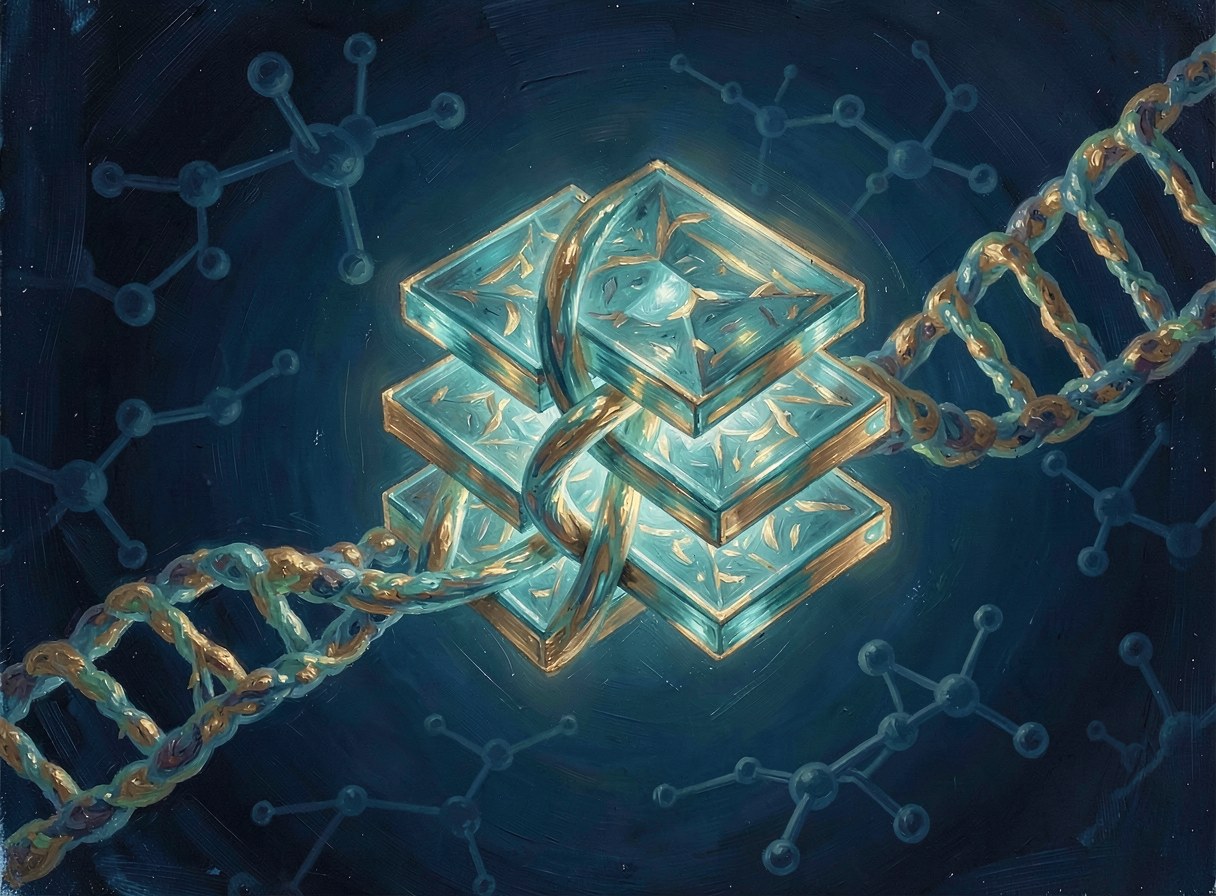
G-quadruplexes are non-canonical four-stranded helical structures that form when stretches of DNA or RNA rich in the base guanine stack into a distinctive architecture held together by potassium or sodium ions. They are not the double helix you learned about in school. They are a different geometry entirely, one that emerges spontaneously when certain G-rich sequences find the right chemical environment.
What makes them genuinely fascinating, and genuinely difficult, is that they are not one structure. A single G-rich sequence can fold into a parallel topology, where all four strands run in the same direction. It can fold into an antiparallel topology, where adjacent strands point in opposite directions. It can even adopt hybrid topologies that mix both arrangements. The specific fold a given sequence adopts depends on the chemical nature of the surrounding solution, the length of the loops connecting the stacked guanine tetrads, and the molecularity of the sequence itself. There is no single answer to the question “what shape does this sequence make?” There is a family of answers, and which one materializes depends on context.
This polymorphism is not a laboratory curiosity. G-quadruplexes present in the human genome play a pivotal role in the regulation of replication, transcription, and translation. They are prospective molecular targets for disease treatment. They appear in over 100,000 locations per genome. And they do all of this while remaining structurally ambiguous, shifting conformation in response to their immediate chemical neighborhood.

The Prediction Problem
Scientists have been working to crack the G-quadruplex prediction problem for years. Machine-learning pipelines now exist that scan a DNA or RNA sequence and flag motifs with a high probability of folding into a four-stranded structure. These tools identify candidate regions, rank them by likelihood, and in some cases propose a specific three-dimensional fold. The computational scaffolding is impressive.
But here is the tension that keeps structural biologists awake at night: the predicted structure and the actual structure are not always the same. The models are trained on known G-quadruplex motifs, and they perform well on average, yet the real molecules in a cellular environment can diverge significantly from the predicted fold. A sequence that the algorithm confidently assigns a parallel topology might, in the crowded ionic landscape of a living cell, settle into a hybrid arrangement the model never considered. The prediction is a best guess, not a verdict. And because the same sequence can adopt multiple valid topologies under different conditions, there is no single “correct” answer to verify against.