

Imagine a creature that swims through the ocean with a secret: every time it jets away from danger, one of its hearts stops beating. This isn’t a flaw in its design—it’s a feature. The octopus, that enigmatic, boneless wonder of the deep, is a masterpiece of evolutionary engineering, built around a circulatory system so unique it sounds like science fiction. With three hearts pumping blue blood through a body of pure muscle and curiosity, the octopus challenges our very understanding of life’s possibilities. Its story isn’t just one of biological oddity, but of elegant solutions to extreme problems, a testament to nature’s boundless creativity.
At first glance, the octopus’s triple-heart system seems extravagant. Why would any animal need three hearts? The answer lies in the fundamental challenge of its existence. As a soft-bodied invertebrate without a rigid skeleton, the octopus’s body is a marvel of flexibility, but this comes at a cost. Its blood, which we’ll soon learn is a remarkable substance, is less efficient at carrying oxygen than the red blood of vertebrates. To compensate, evolution crafted a brilliant two-stage pumping system.
Two of its hearts, known as the branchial hearts, are dedicated specialists. Their sole job is to pump deoxygenated blood through the gills, where it picks up precious oxygen from the water. This is the critical first step, ensuring the blood is saturated before it goes anywhere else. The third heart, the systemic heart, then takes over. It receives this freshly oxygenated blood and pumps it powerfully to the rest of the body—to the brain, the arms, the organs. This division of labor is incredibly efficient. It allows the octopus to maintain high blood pressure and deliver oxygen effectively despite the physical constraints of its body plan.
But here’s the twist that makes this system even more fascinating: when an octopus swims, its systemic heart stops beating. Swimming is an incredibly energy-intensive activity for these creatures, and the movement seems to interfere with the heart’s rhythm. So, they rely on their two branchial hearts to keep oxygen flowing during these bursts of speed. This is why octopuses are such masters of the seafloor—they prefer to crawl, glide, or use their siphon for short, explosive escapes, reserving swimming for when it’s absolutely necessary. It’s a beautiful, if exhausting, adaptation.
Now, let’s talk about the color. Why is octopus blood blue? The answer takes us into the realm of chemistry and deep evolutionary history. In humans and most vertebrates, blood is red because of hemoglobin, an iron-based protein in our red blood cells that binds to oxygen. Octopuses, along with their cephalopod cousins like squid and cuttlefish, use a different molecule entirely: hemocyanin.
Hemocyanin is a copper-based protein. Instead of being packed into cells, it floats freely, dissolved directly in the octopus’s blood plasma. When hemocyanin binds with oxygen, the copper atoms within it undergo a chemical change, turning the blood a vivid, striking blue. This isn’t just a pretty quirk; it’s a functional adaptation. Scientists believe hemocyanin is particularly effective in the cold, low-oxygen, high-pressure environments of the deep sea where many octopuses live. It’s nature’s third known solution to the problem of oxygen transport, a separate evolutionary path from the hemoglobin of vertebrates and the hemerythrin of some marine worms.
The discovery of this blue blood is a story in itself, a human tale of curiosity and connection. The first clue came in 1833, when Venetian chemist Bartolomeo Bizio was studying the famous purple dye extracted from murex sea snails. In his work, he identified the presence of copper in the blood of these mollusks—a serendipitous finding that opened a new chapter in biology. Decades later, in 1878, Belgian physiologist Léon Fredericq isolated the blue pigment itself, naming it hemocyanin. What began as an investigation into ancient dye-making led to the understanding of a fundamental biological system, showing how science often advances through unexpected connections.
This copper-based system is a double-edged sword, a trade-off that shapes the octopus’s entire life. While hemocyanin is superb in cold water, it is less efficient in warmer conditions. This may help explain why octopuses are not the long-lived, slow-growing creatures of the sea. The common octopus, for instance, lives a breathtakingly short life of just one to two years. They are creatures of intense, rapid living—growing quickly, solving complex problems, and exploring their world with a renowned intelligence. Their biology is optimized for performance, not longevity. After a single, often singular, reproductive event, their life cycle is complete. The female will guard her eggs with fierce devotion until they hatch, and then her journey ends. It’s a poignant reminder that in nature, every adaptation comes with a cost, and every design is a balance between competing needs.
Yet, within this short lifespan, the octopus achieves wonders. With a nervous system more complex than many vertebrates, they are escape artists, puzzle-solvers, and masters of camouflage. Their three hearts and blue blood are not limitations but the very foundation of their success, enabling a lifestyle of incredible agility and intelligence. They are living proof that there is no single “right” way to build a successful animal. Life explores countless paths, and the octopus took a path of copper, flexibility, and triple-powered circulation.
As we study these remarkable creatures, we do more than learn about marine biology. We learn about the principles of engineering, the possibilities of alternative biochemistries, and the sheer diversity of life’s solutions to universal challenges. The octopus, with its alien-like anatomy and profound intelligence, invites us to think differently about what is possible. It reminds us that innovation isn’t just a human endeavor; it’s woven into the very fabric of life on Earth.
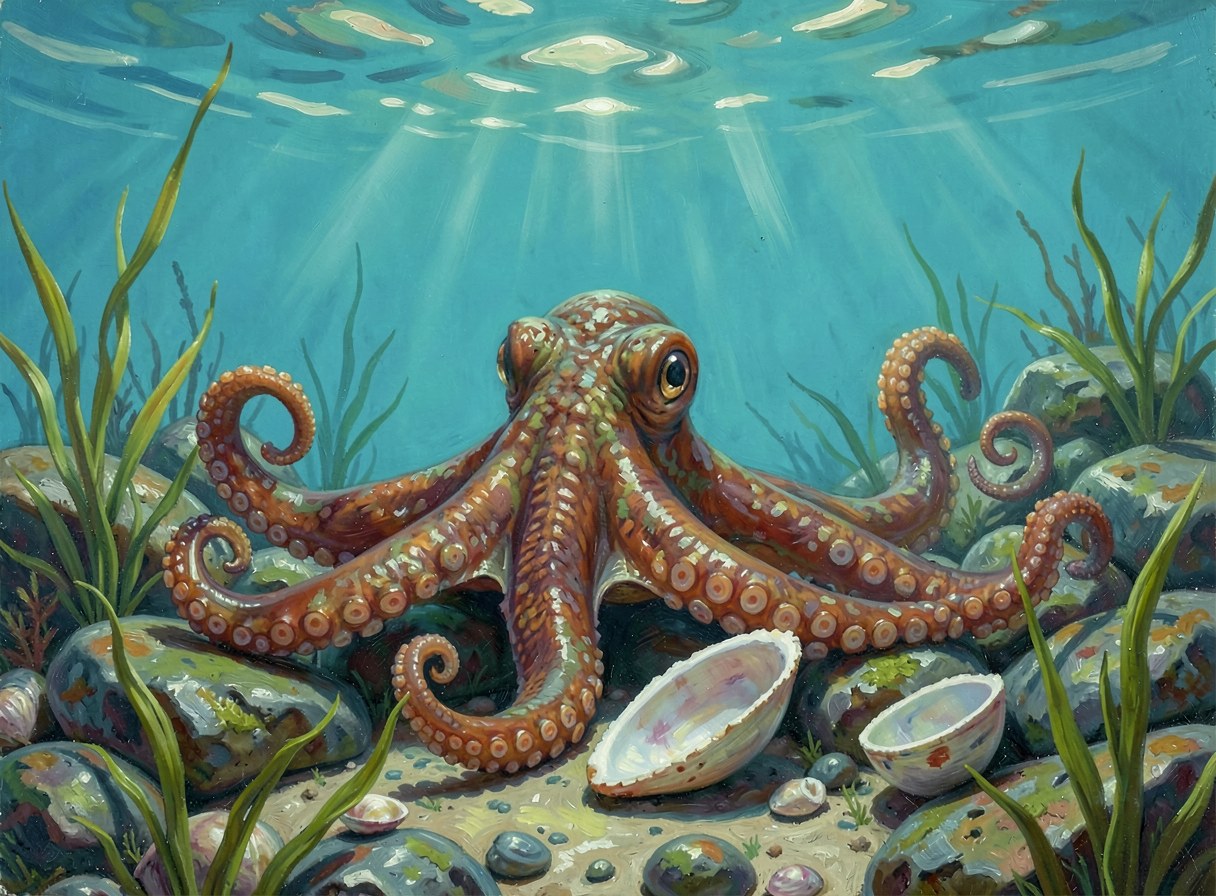
So, the next time you see an image of an octopus gliding silently over a reef, remember the silent, intricate machinery within: two hearts pumping at the gills, one pausing as it swims, and a river of blue blood coursing through its veins. It’s a system refined over hundreds of millions of years, a testament to resilience and adaptation. What other secrets, we have to wonder, are still flowing through the blue-blooded veins of the deep, waiting for a curious mind to uncover them?