Somewhere in a drawer near you there is a safety pin. It has a story, and part of it is even true.
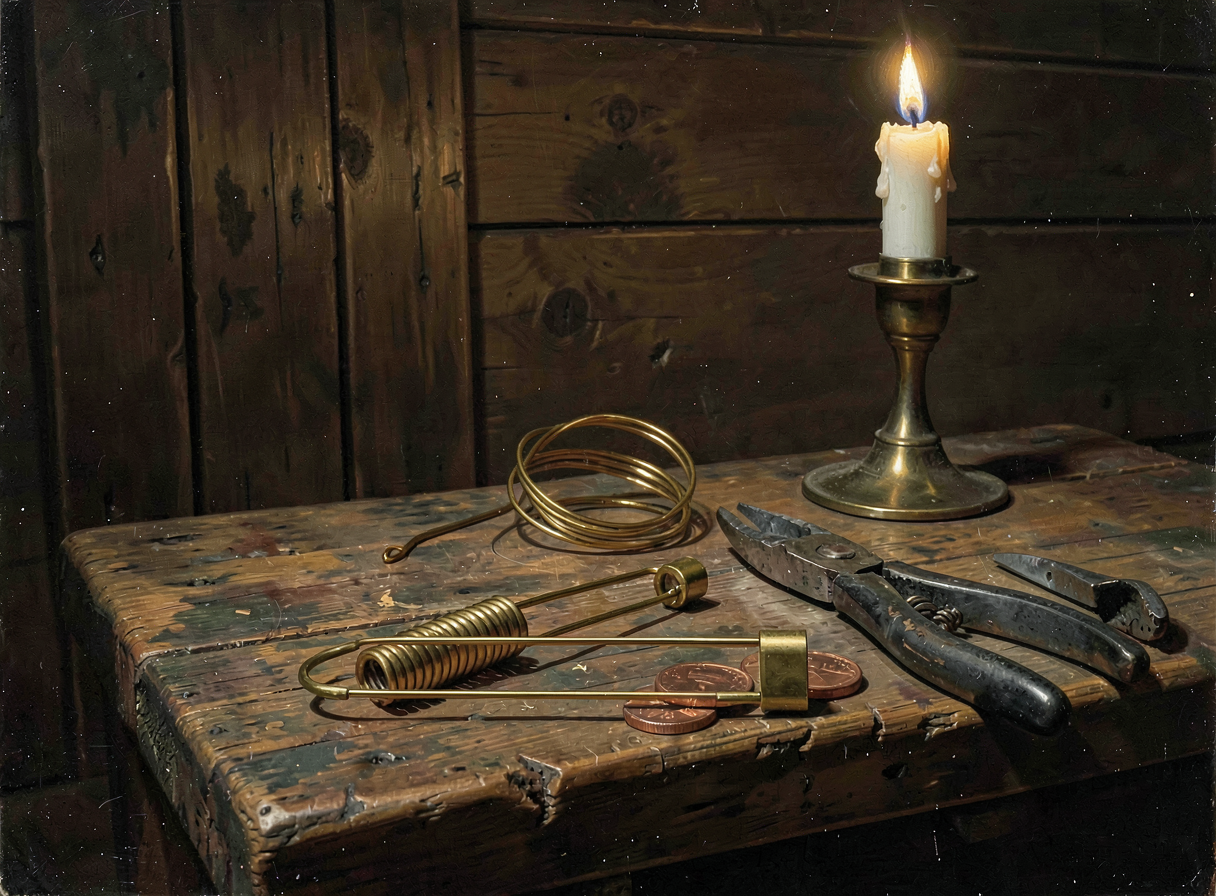
On 10 April 1849 the United States Patent Office granted patent number 6,281 to Walter Hunt of New York for an object he called a “Dress-Pin”. Look at the drawing and you know it at once: a single piece of wire, bent so that one end coils into a little spring and the point tucks under a clasp that covers it. That’s the whole idea. The spring keeps the pin closed, and the clasp keeps the point from pricking.
The story usually told is this. Hunt owed fifteen dollars and needed to pay. So he picked up a length of wire, twisted it for about three hours, and came out with the safety pin. Then he sold the rights for four hundred dollars and never earned another cent from it. The fifteen dollars and the four hundred appear in the profiles of the National Inventors Hall of Fame and of MIT’s Lemelson programme. The three hours come from older tellings that begin with “it is said”.
Hunt was a restless inventor. Around 1833 or 1834 he built one of the first sewing machines with a lockstitch and an eye-pointed needle, and he did not patent it. When he finally tried, in 1853, Elias Howe already held the patent. He also designed a repeating rifle and a paper collar, and others made the money on both. He died in 1859.
What we don’t know. Who bought the rights. Many websites say W. R. Grace and Company, but the patent record names two other men, William and John Richardson. Why he left the sewing machine unpatented is unclear as well. The famous answer is that he didn’t want to put seamstresses out of work, but he had also sold half of the rights to a backer who never built it. The “three hours” may be just a good anecdote.
What remains certain is the pin itself: one wire, one spring, one clasp, and nothing to add after 177 years.
Sources: US Patent 6,281, “Dress-Pin”, Walter Hunt, 1849 (Google Patents copy of the USPTO record); Lemelson-MIT Program, Walter Hunt; National Inventors Hall of Fame, Walter Hunt; Wikipedia, Walter Hunt (inventor).