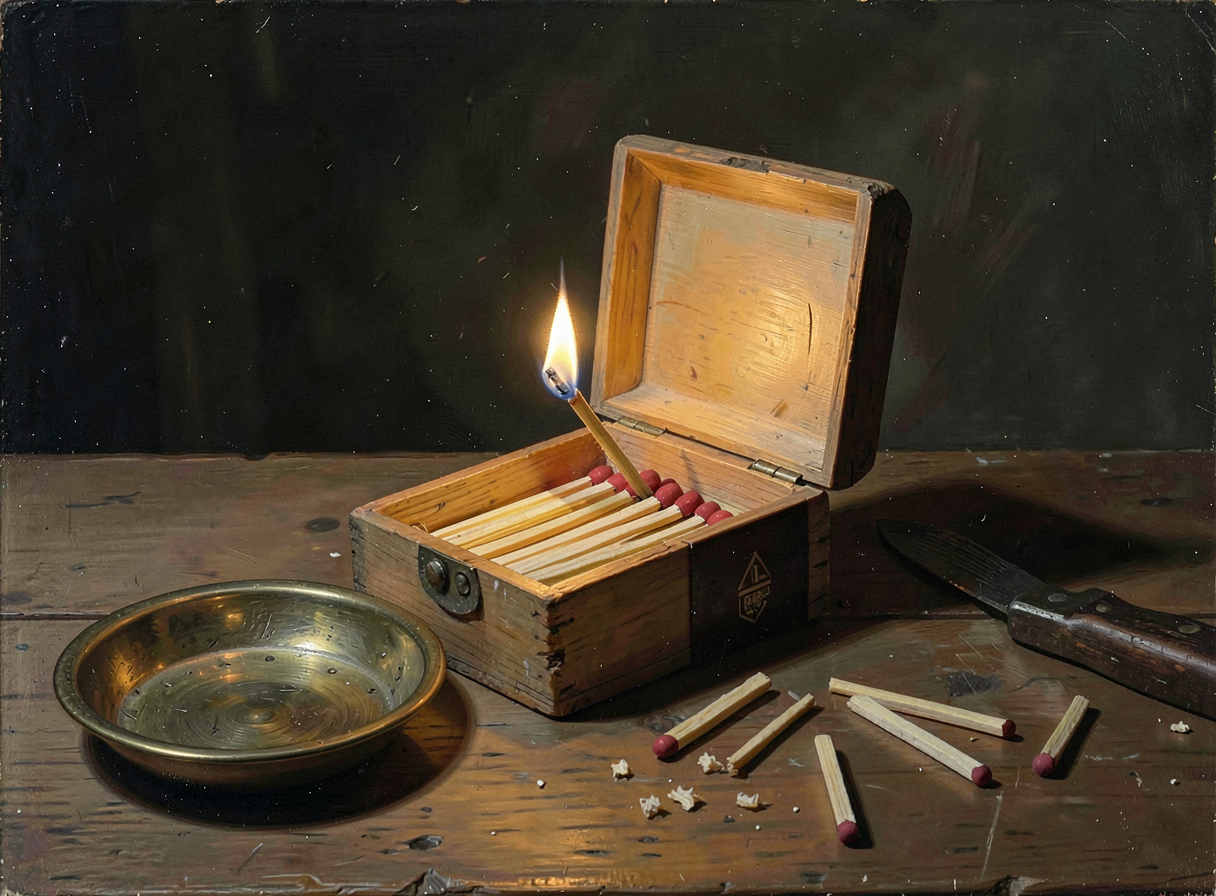
Strike a kitchen match on the wall and nothing happens. That small failure is the whole invention.
For most of the nineteenth century, a match could be lit on almost anything: a boot sole, a brick, a trouser leg. The secret was white phosphorus in the head, a substance so eager to burn that it glows in the dark. It was also poisonous. The people who paid the price were not the smokers, but the workers who dipped the matches. Breathing phosphorus fumes day after day gave many of them “phossy jaw”, a disease that slowly destroyed the bone of the jaw.
In 1844 a Swedish chemist, Gustaf Erik Pasch, patented a different idea. He split the match in two. The head kept the chemicals that burn, the box got the phosphorus, and he used red phosphorus, a much tamer form made by heating the white kind in a closed vessel. Neither half could ignite on its own. Only together, at the moment of striking, did they make fire.
Pasch did not manage to make a business of it, and production in Stockholm soon stopped. In Jönköping, the brothers Johan Edvard and Carl Frans Lundström improved the recipe and built a factory. Their safety match won a prize at the Paris Exposition of 1855, and the “Swedish match” went around the world.
White phosphorus took much longer to disappear. Only on 26 September 1906 did a convention signed in Berne ban it from matches, along with their import and sale. It came into force on 1 January 1912.
What we don’t know. The dates around the Lundströms do not agree: sources put the start of the Jönköping factory anywhere between 1845 and 1852, and it is unclear whether the famous 1855 patent was Swedish or the British licence granted to Bryant & May. The safer match was ready in 1844. The law protecting the workers came sixty-two years later.
Sources: Royal Society of Chemistry, Education in Chemistry, John Emsley on phosphorus; Wikipedia, Gustaf Erik Pasch; Wikipedia, Johan Edvard Lundström; Wikipedia, Berne Convention (1906); Wikipedia, Phossy jaw.