
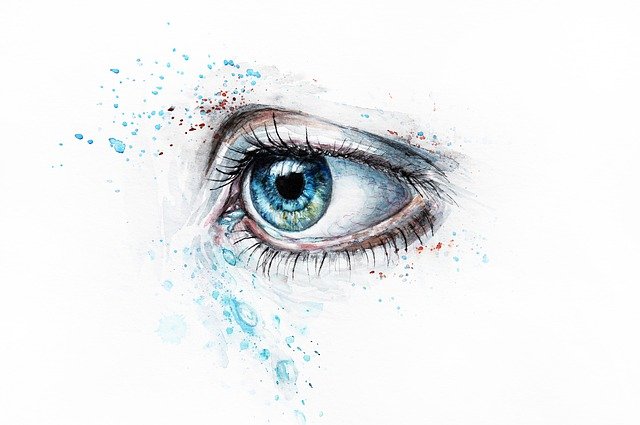
Your pupils might reveal how strong your “mind’s eye” is.
If you have trouble visualizing objects in your mind, you’re not alone. You might have aphantasia.
by Monisha Ravisetti from: cnet.com
Picture a red apple. Great. Now, which of the following describes you?
Group 1: You’re visualizing a vibrant, ruby-colored fruit as if it lived in your mind.
Group 2: You’re reflecting on the concept of an apple without getting any mental image at all.
If you’re in the first group, you might be wondering whether group 2 misunderstood the question. If you’re in the second group, you might find it extremely strange that group 1 exists. And group 2 might have aphantasia.
What is aphantasia?
In a nutshell, aphantasia is the inability to form mental images of objects that are not in your line of sight.
For my fellow group 1 daydreamers, think of it as being like imagining something you’ve never seen before but still know about. You can consider the concept and maybe even list facts about it, but you can’t “see” the object, unless you’re conjuring up an image of how you suspect it might look. For aphantasics it’s always like that. Forming a visceral mental scenario just isn’t an option.
“When I close my eyes, I experience only darkness, I have no sensory experience at all,” writes Neesa Sunar in a Psyche article about the phenomenon. And on the aphantasic way of life, “when we’re told to ‘imagine a beach,’ we think it simply means imagining the concept of a beach. When we’re told to ‘count sheep’ as we fall asleep, we don’t realize that people can actually see sheep jumping over a fence.”
…
Measuring the mind’s eye
Ever since Francis Galton formally described aphantasia in the late 1800s, psychologists, philosophers and neurologists have worked to clarify the concept. This 2020 paper, for example, sought to find a “cognitive fingerprint” for aphantasia, and another, from 2021, explored a question often asked about aphantasics: Can they dream?
That’s where the March 2022 research study comes in, and why it could be a big deal.
A team at the University of New South Wales in Sydney has found a way to check whether a person has aphantasia by measuring the dilation of their pupils. The researchers are part of the Future Minds Lab, an experimental startup that aims to decode psychological phenomena.
“This is really the first biological and objective test for imagery vividness,” said Joel Pearson, professor and senior author of the paper, in a statement about the study.
After studying the pupillary reflexes of 42 study participants, some of whom identified as aphantasic, it was seen that the pupils of both non-aphantasics and aphantasics clearly dilated when they physically looked at objects in front of them. However, only the pupils of non-aphantasics showed an equally strong response when they visualized those objects in their mind.
“While it was already known that imagined objects can evoke so-called ‘endogenous’ changes in pupil size, we were surprised to see more dramatic changes in those who reported more vivid imagery,” Pearson said.
…
Cognition, philosophically
The idea of measuring human minds forces us to ask ourselves a series of fascinating philosophical questions about cognition. If we can detect mental images, perhaps we can solve other mysterious psychological puzzles.
For example, a long-standing debate among philosophers of language is whether the words we use to describe our thoughts are enough to make another person experience what is going on in our mind.
…
“It’s a really exciting time,” Pearson said. “We’re very close to having objective and reliable tests for extreme imagery, aphantasia and hyperphantasia – extremely strong visual imagery – that could be scaled up to be run online for millions of people everywhere.”
It’s human nature to wonder whether you’re in group 1 or group 2. It’s also quite fun.