NASA’s DART spacecraft just crashed into an asteroid, on purpose
It is the first-ever attempt to knock a space rock off course
Update of October 12, 2022
by Eric Mack from: cnet.com
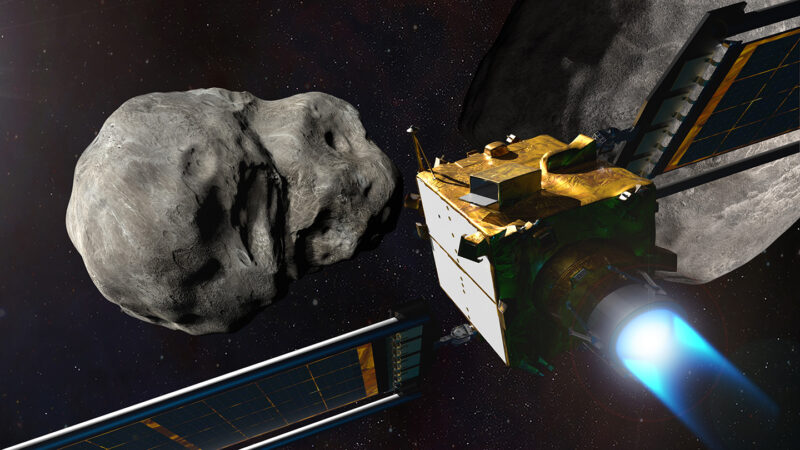
NASA has succeeded in changing the orbit of the asteroid Dimorphos. NASA crashed its Double Asteroid Redirection Test spacecraft, known as DART, into Dimorphos a few weeks ago to test a possible method of protecting Earth from a dangerous body on a collision course with our planet.
“This is a watershed moment for planetary defense and for humanity,” said NASA Administrator Bill Nelson, confirming the asteroid’s redirection during Tuesday’s press conference.
To be clear, this was only a test of a potential defense method, called “kinetic impactor deflection,” which does not require nuclear weapons or celebrities on a suicide mission as in the most popular Hollywood films, such as 1998’s Armageddon. Dimorphos, which is actually a moonlet orbiting the larger asteroid Didymos, poses no real threat to Earth. In fact, no asteroid or near-Earth object is considered a threat to humanity, but there are still many space rocks and comets out there that have yet to be discovered or tracked by astronomers.
DART’s impact with Dimorphos, which took place on September 26, appears to have cut 32 minutes from the time it takes the moon to orbit Didymos, from 11 hours and 55 minutes to 11 hours and 23 minutes, with a margin of uncertainty of about two minutes. NASA hoped DART would change the orbital period by at least 73 seconds, but expected that it might alter the orbit by at least a few minutes and perhaps by tens of minutes. The result therefore falls at the upper end of the expected possibilities.
…
(Full article in English here)
——————————————————————————————
By , Source: ScienceNews
Mission control rooms rarely celebrate crash landings. But the collision of NASA’s DART spacecraft with an asteroid was a smashing success.
At about 7:15 p.m. EDT on September 26, the spacecraft plunged into Dimorphos, an asteroid moonlet orbiting a larger space rock called Didymos. The goal of the mission was to bring Dimorphos slightly closer to its parent asteroid, shortening its 12-hour orbit around Didymos by several minutes.
The Double Asteroid Redirection Test , or DART, is the world’s first attempt to change the motion of an asteroid by ramming a spacecraft into it ( SN: 30/06/20 ). Neither Dimorphos nor Didymos poses a threat to Earth. But seeing how well DART’s maneuver worked will reveal how easy it is to tamper with an asteroid’s trajectory, a strategy that could protect the planet if a large asteroid were ever discovered on a collision course with Earth.
“We don’t know of any large asteroids that would be considered a threat to Earth coming in the next century,” says DART team member Angela Stickle, a planetary scientist at the Johns Hopkins University Applied Physics Laboratory in Laurel, Md. “The reason we’re doing something like DART is because there are asteroids we haven’t discovered yet.”
Astronomers have spotted nearly all the kilometer-sized asteroids in the solar system that could end civilization if they struck Earth, says Jessica Sunshine, a planetary scientist at the University of Maryland in College Park who is also on the DART team. But when it comes to space rocks about 150 meters wide, like Dimorphos, “we only know where about 40 percent of those are,” Sunshine says. “And that’s something that, if it hit, would definitely destroy a city.”
Dimorphos is a safe asteroid to give an experimental push, says Mark Boslough, a physicist at Los Alamos National Laboratory in New Mexico who has studied planetary protection but is not involved in DART. “It’s not on a collision course” with Earth, he says, and DART “can’t hit it hard enough to put it on a collision course.” The DART spacecraft weighs only about as much as a couple of vending machines, while Dimorphos is thought to be nearly as heavy as the Great Pyramid of Giza in Egypt.
After a 10-month journey, DART met Didymos and Dimorphos near their closest approach to Earth, about 11 million kilometers away. Until the end of its journey, DART could see only the larger asteroid, Didymos. But about an hour before impact, DART spotted Dimorphos in its field of view. Using its onboard camera, the spacecraft steered toward the asteroid moonlet and crashed into it at about 6.1 kilometers per second, or nearly 14,000 miles per hour.
– Continued …
(Full article in English here…)
(Image from the NASA website)