

Introduction:
Human beings have always wondered about the nature of reality, the boundaries of the universe and the possibility of other worlds. In recent years, the concept of the “multiverse” has captured the imagination of scientists, artists and the general public. But what exactly does the multiverse mean? And how does it differ from the much-discussed “metaverse”?
Definitions:
Let’s start by defining the multiverse: it is a scientific hypothesis that theorizes the existence of multiple universes, each with its own physical laws and its own evolutionary history. It is a concept that pushes us to the limits of our understanding, inviting us to imagine a reality far grander and more complex than we ever thought possible.
Here are the most widely recognized theories supporting the existence of the multiverse:
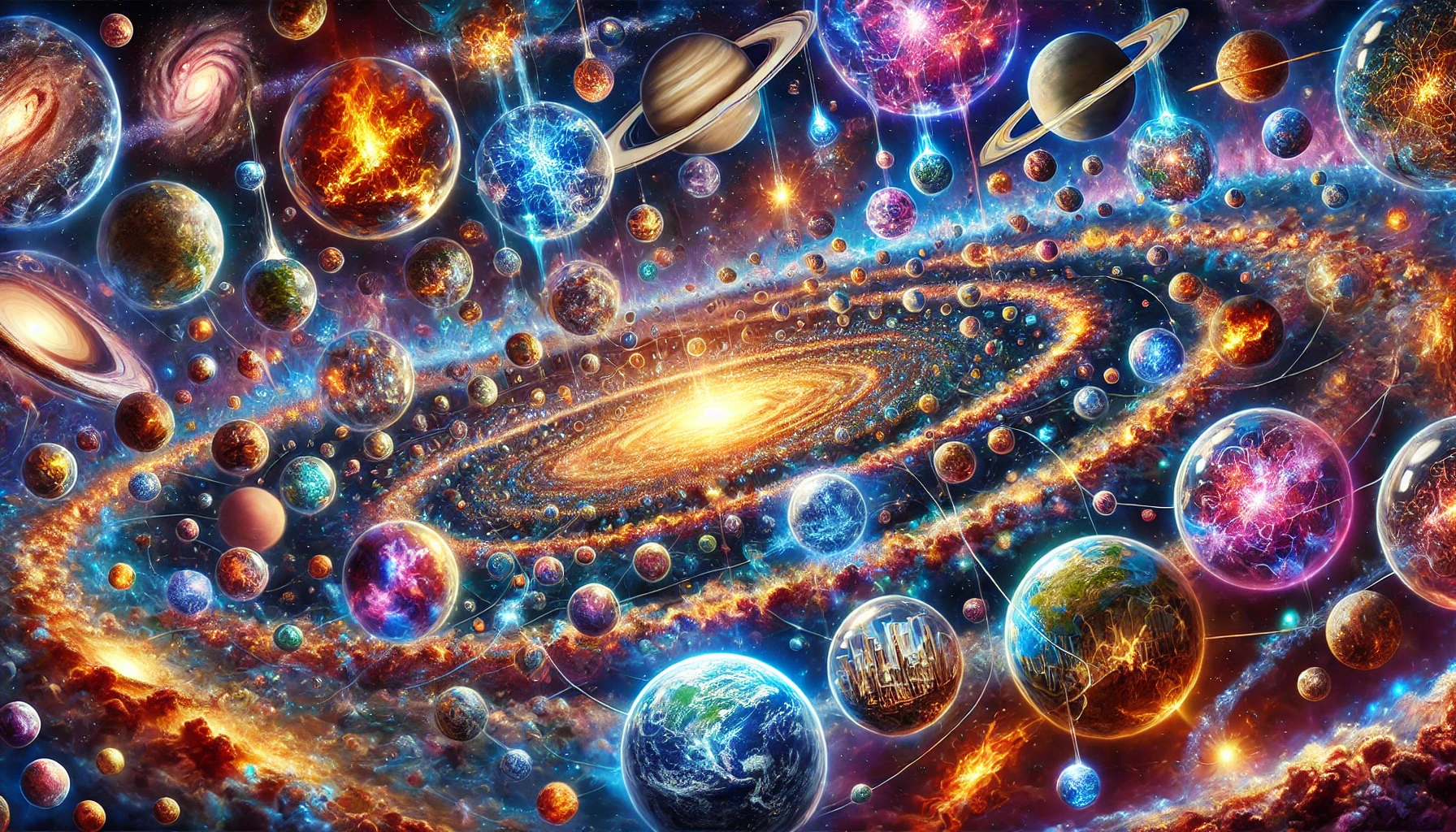
● Cosmic Inflation: Developed by Alan Guth and Andrei Linde, this theory suggests that the universe, right after the Big Bang, expanded at an exponential rate, giving rise to a multitude of “bubble” universes. Picture it this way: in the first fraction of a second after the Big Bang, the universe went through a period of rapid expansion, swelling faster than the speed of light. This inflationary period could have created different regions of spacetime, each of which evolved into a separate universe.
● Many-Worlds Interpretation: Based on the work of Hugh Everett, this theory posits multiple branching timelines, in which every possible quantum outcome generates a new universe. Imagine a reality in which every decision you make, every path you don’t take, splits off into a separate universe. In one universe, you chose to have coffee this morning; in another, you went for tea. The Many-Worlds Interpretation suggests that all these possibilities exist, each one playing out in its own separate reality.

Although there is still no definitive evidence for the multiverse, the hypothesis is fascinating for the philosophical and scientific implications it carries. If a multiplicity of universes really existed, we might explain still-mysterious phenomena in our world and imagine infinite versions of ourselves living completely different lives.
Now let’s distinguish the multiverse from the metaverse. While the former is a theoretical concept concerning the existence of multiple physical universes, the metaverse is a virtual reality accessible through technological tools such as augmented reality and virtual reality. Think of the metaverse as a digital realm where you can interact with others, play games, take part in virtual events and even do business. Although it is a fascinating concept with potential for innovation, it exists within our one and only universe. It is an evolving reality that offers new opportunities for social interaction, entertainment and work.
Both concepts invite us to broaden our horizons and look beyond the boundaries of the reality we know.
Diving Deeper into the Multiverse
While the idea of a multiverse might sound like science fiction, it has its roots in theoretical physics. Let’s explore the theories in more detail to better understand their mind-bending implications.
Cosmic Inflation and Its “Bubble Universes”: The rapid expansion of the universe during cosmic inflation could have created regions so vast and distant that they are effectively separate universes. These “bubble universes” could have different physical laws and constants, leading to an unimaginable diversity of realities.
The Many-Worlds Interpretation and Quantum Splitting: The Many-Worlds Interpretation delves into the strangeness of quantum mechanics. At the quantum level, particles can exist in multiple states at the same time until they are observed. This interpretation suggests that every observation causes a split in reality, creating a new universe for every possible outcome.
Implications and Anomalies of the Multiverse
The concept of the multiverse is as baffling as it is captivating. It raises profound questions about our place in the cosmos and about the very nature of reality. Here are some of the implications and complications that come from considering the possibility of a multiverse:
● The infinite you: If the multiverse exists, it implies an infinite number of versions of you, each living a different life. What does this mean for your sense of identity and free will? And for the famous ‘uniqueness’ of each of us? Shall we talk about it?
● The meaning of existence: In a multiverse, our universe might be just one among countless others, making our existence statistically insignificant. How does this affect our understanding of the meaning and purpose of life?
● The limits of knowledge: Can we ever truly know other universes, if they exist? How would we even begin to observe them or interact with them?
Final Thoughts:
The multiverse and the metaverse are distinct concepts, but both challenge us to contemplate the limits of our perception and the nature of reality. Even if we never find concrete evidence of the multiverse, contemplating it pushes us to expand our understanding of the cosmos and to appreciate the vastness of the unknown. The journey of exploration has only just begun, and we can only marvel at the discoveries and innovations that await us in the future.