


Puzzling observations of distant galaxies are challenging cosmologists’ prevailing ideas about the universe, potentially leading to the implication that the strange substance called dark matter does not exist.
That is one possible conclusion of a new study published June 20 in The Astrophysical Journal Letters. The finding “raises questions of an extraordinarily fundamental nature,” says Richard Brent Tully, an astronomer at the University of Hawaii at Manoa, who was not involved in the work.
Astronomers suspect that dark matter exists because of the way stars and other visible material rotate at the visible edges of a galaxy. The rotation speeds of objects far from the galactic center are much higher than they should be, given the amount of luminous matter observed in telescopes. According to physicists’ current understanding of gravity, this implies that a massive reservoir of invisible matter is exerting a gravitational pull on those stars.
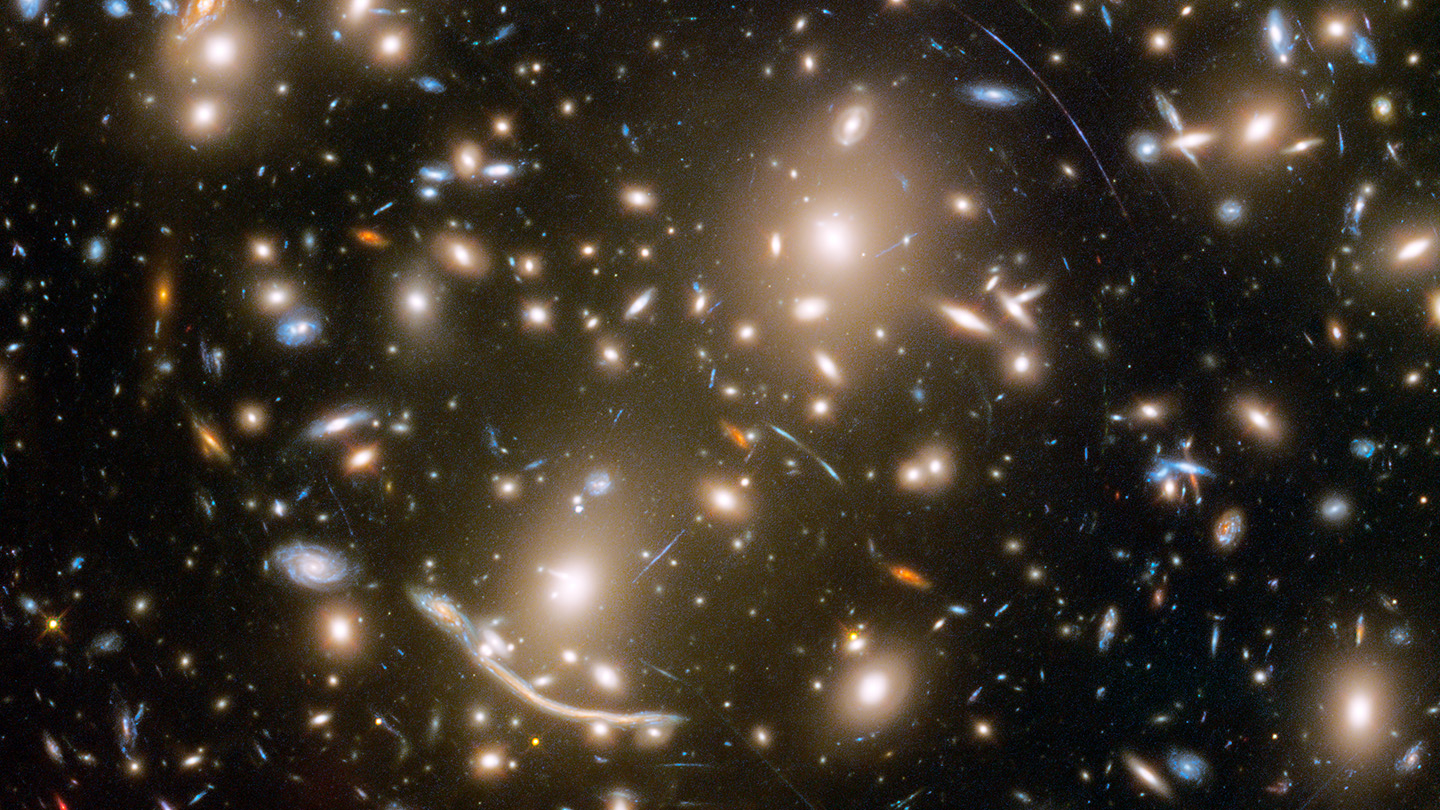
The new results rely on the fact that massive objects warp the fabric of space and time. Galaxies are made up of enormous amounts of visible stars, gas and dust, plus, according to theory, a vast halo of invisible dark matter. This means that light will be bent and distorted as it travels past a galaxy, an effect known as gravitational lensing.
Knowing this, astronomer Tobias Mistele of Case Western Reserve University in Cleveland and his colleagues set out to look for signs of gravitational lensing around different galaxies as a way of probing the contents of the galaxies themselves. The team examined a catalog of about 130,000 galaxies imaged by the VLT Survey Telescope at the European Southern Observatory’s Paranal Observatory in Chile, looking for those telltale streaks that indicate the presence of more distant galaxies whose light has been bent and distorted by the intervening objects.

The amount of lensing gives an indication of the masses of the foreground galaxies, including both their luminous matter and, presumably, the much larger amount of dark matter surrounding each galaxy. The team then calculated the mass at various distances from the center of each galaxy and used it to infer the speed at which a star would orbit at those distances.
According to the prevailing cosmological model, called Lambda CDM, dark matter clumps together into enormous clusters across the cosmos, and the gravitational pull of these clusters draws in visible matter, which goes on to form a galaxy (SN: 4/4/24). Previous observations have established that these halo-like clumps extend out to at least 300,000 light-years from a galaxy’s center. Beyond that limit, the rotation speeds of stars should begin to slow down.
Yet, using their gravitational lensing data, Mistele and his colleagues calculated that a star located a million light-years from the center of each galaxy, and potentially up to 3 billion light-years away, would still be rotating too fast, considering both the visible and the dark matter thought to be present in the galaxy.
Does this mean there is even more invisible material than previously thought? Maybe not.
A rival theory to Lambda CDM, known as modified Newtonian dynamics, or MOND, does away with the concept of dark matter altogether and suggests instead that gravity behaves differently on the scale of galaxies (SN: 3/28/18). Long championed by Mistele’s co-author Stacy McGaugh, also of Case Western, MOND specifically predicts the kinds of observations found in the study.
But Lambda CDM is not out of the fight yet.
“I think it’s a stretch to say that you can do away with dark matter, because the lines of evidence [in its favor] are so numerous,” says Bhuvnesh Jain, a cosmologist at the University of Pennsylvania.
For example, the growth of large-scale structures in the universe since the Big Bang is explained much better by Lambda CDM than by MOND. Jain suggests that perhaps there are even more exotic ideas in mathematical models of gravity, inspired by the higher-dimensional thinking found in string theory, that could explain the current large-scale structure of the universe. Some variations of such ideas might be able to explain the data of Mistele and his colleagues while also revising the role of dark matter.
Observations from the European Space Agency’s Euclid satellite, launched last year, will soon provide researchers with much better gravitational lensing data, potentially helping to untangle what is going on in this strange mystery.