
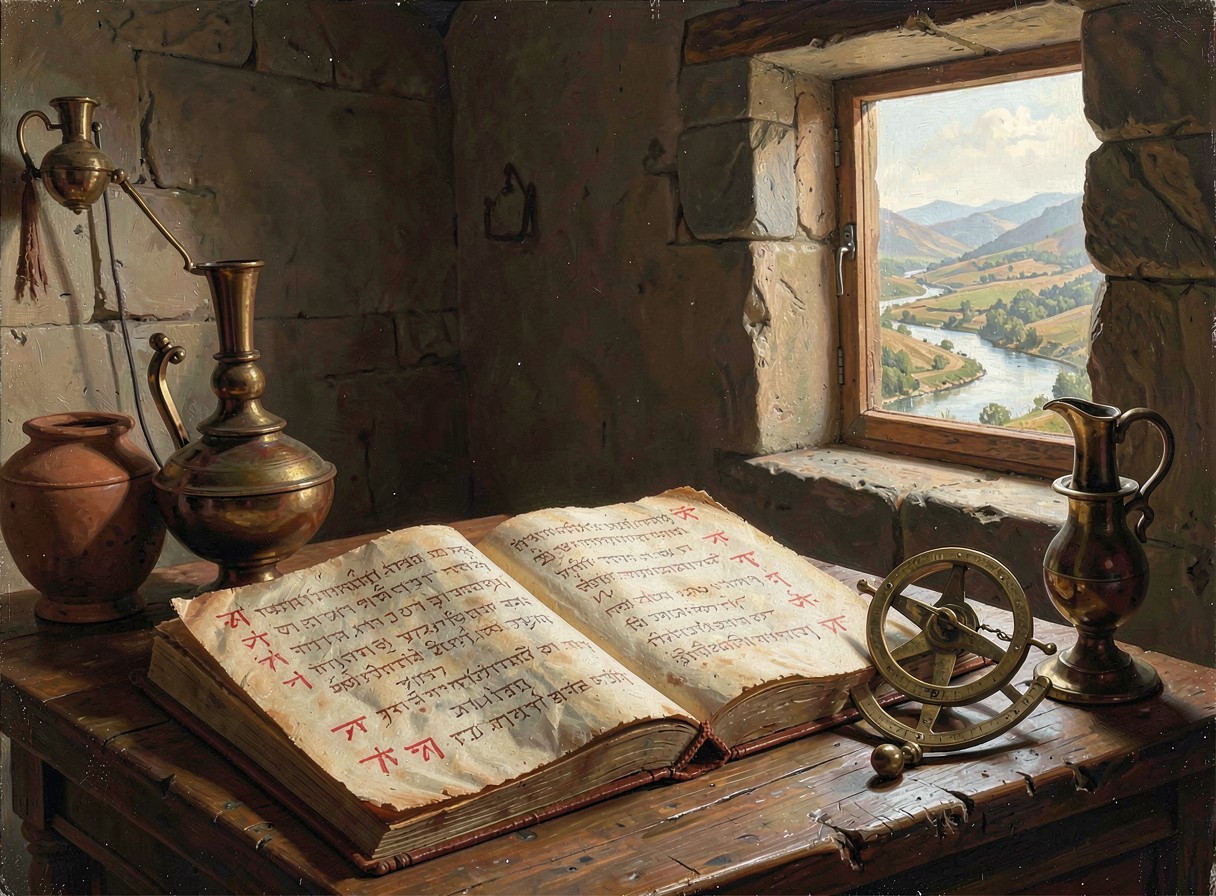
“this computation is done by means of nine signs” — Severus Sebokht, 662
Severus Sebokht was a seventh-century Syriac scholar, expert in astronomy: he wrote the oldest known treatise on the astrolabe. In a text of 662 he praised the science of the Indians: their astronomical discoveries, he said, surpass those of the Greeks and the Babylonians, and their way of calculating, done with nine signs, is beyond all words.
His aim was polemical. He wanted to show that science is not the monopoly of those who speak Greek, and he added with irony that if those who believe they have reached the limits of science because they speak Greek knew these things, they would realise that others know something too.
It is the oldest certain mention of Indian numerals outside India. In Europe the first appearance in a Latin manuscript dates from 976, in Spain, still without zero. Fibonacci made them known to merchants in 1202, but they truly spread only with printing, in the fifteenth and sixteenth centuries.
A word of caution. Sebokht speaks of nine signs, not ten: according to some he did not know zero, according to others the text does not allow us to decide. His exact words reach us through modern translations of a Syriac manuscript kept in Paris, published in 1910, and the versions differ slightly. His title of bishop and the confession of his monastery are reported differently by the sources.
This story is one of the rooms of the Museum of Missed Chances, where inventions and ideas that came too early hang as paintings.
Sources: Wikipedia, History of the Hindu-Arabic numeral system; Severus Sebokht, encyclopedia entry (unnamed website); Max Planck Institute for the History of Science, ISMI, record of the text by Sebokht (excerpt only); Encyclopaedia Britannica, Numeral (excerpt only); MacTutor, Arabic numerals (University of St Andrews).