


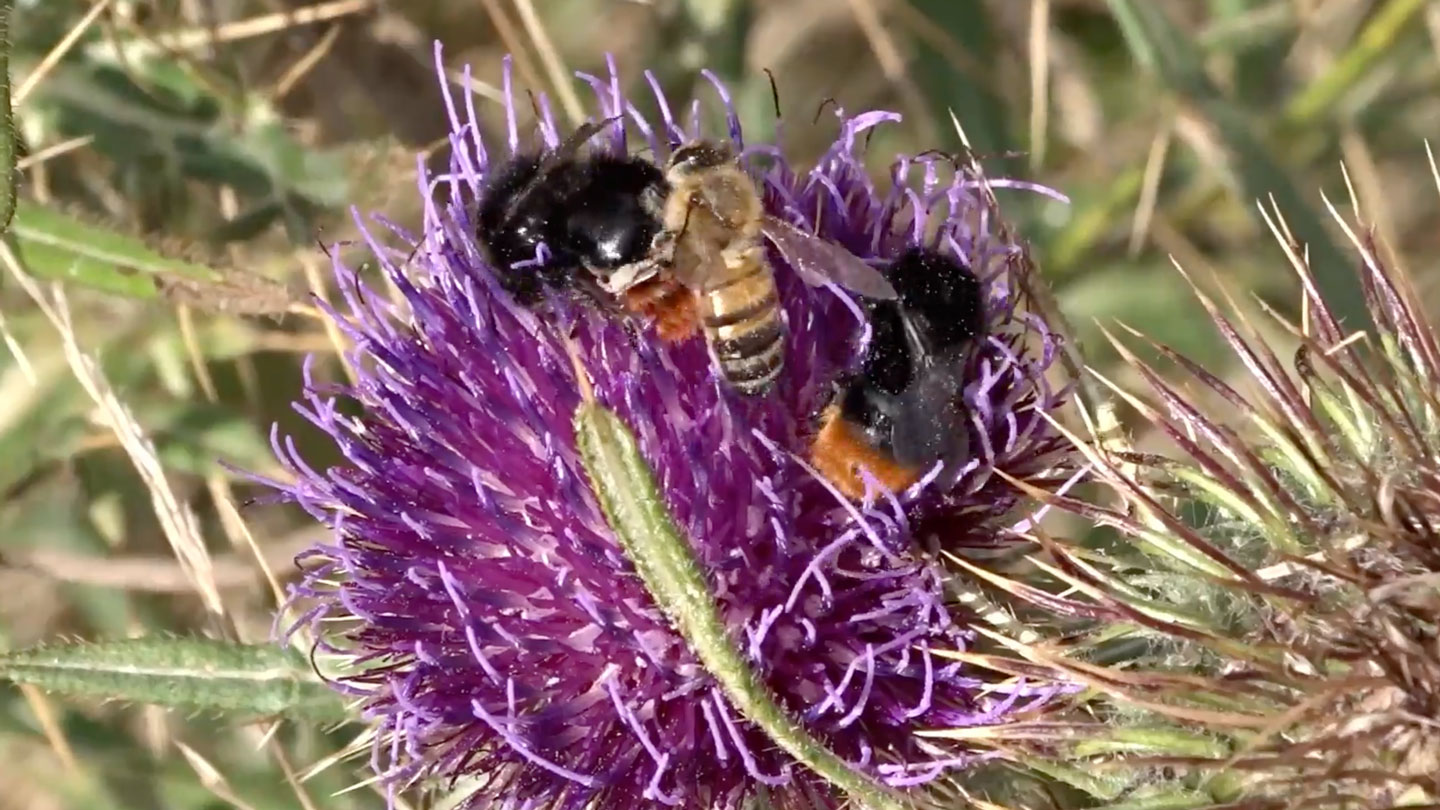
Honeybees rely on plant pollen as a protein-rich food source. And some are even willing to steal from other bees to get it.
Pollen theft has already been observed in the United States. But now researchers in Italy have also observed honeybees stealing pollen from the backs of bumblebees. The observations, published December 21 in Apidologie, are among the most extensive documentation of bee-on-bee theft to date.
During a summer hike in 2019 on Mount Antola, in the northern Liguria region, independent naturalists Tiziano Londei and Giuliana Marzi, both based in Milan, filmed what they thought were honeybees (Apis mellifera) trying to push bumblebees off the flower of a woolly thistle (Cirsium eriophorum). A closer look at the video, however, revealed that this was not a case of competitive harassment, but outright theft.
“Honeybees are notoriously pollen hogs,” explains Avery Russell, a biologist at Missouri State University in Springfield who was not involved in the study. So stealing pollen from bumblebees’ bodies, he says, “doesn’t seem like a stretch.”
To check how frequent this offense is, the researchers returned to the site twice over the following three years and also observed bees at two other sites about 25 kilometers away. The bees at these other sites were not seen stealing from bumblebees, but the bees at the first site kept stealing year after year. For example, honeybees collected pollen from only three of the 31 flowers the researchers observed in 2021, but stole from 28 of the 66 available bumblebees.
Analyzing the differences between these sites, the researchers suspect that honeybees resort to theft in areas where pollen is hard to get from flowers (honeybees struggled to collect pollen from the woolly thistle), but where there are plenty of other bees around.
Pollen theft by honeybees had previously been observed only in North America, first in Kansas and then in California and Indiana. The discovery of this behavior in Italy suggests it could be a global crime. Russell says it would be good to find out whether pollen theft has a negative impact on bumblebees or on the flowers they pollinate. He is also curious whether other bee species steal pollen too. “We’ve noticed that in the hive, bumblebees nibble on each other’s pollen baskets.”
Link to the source