


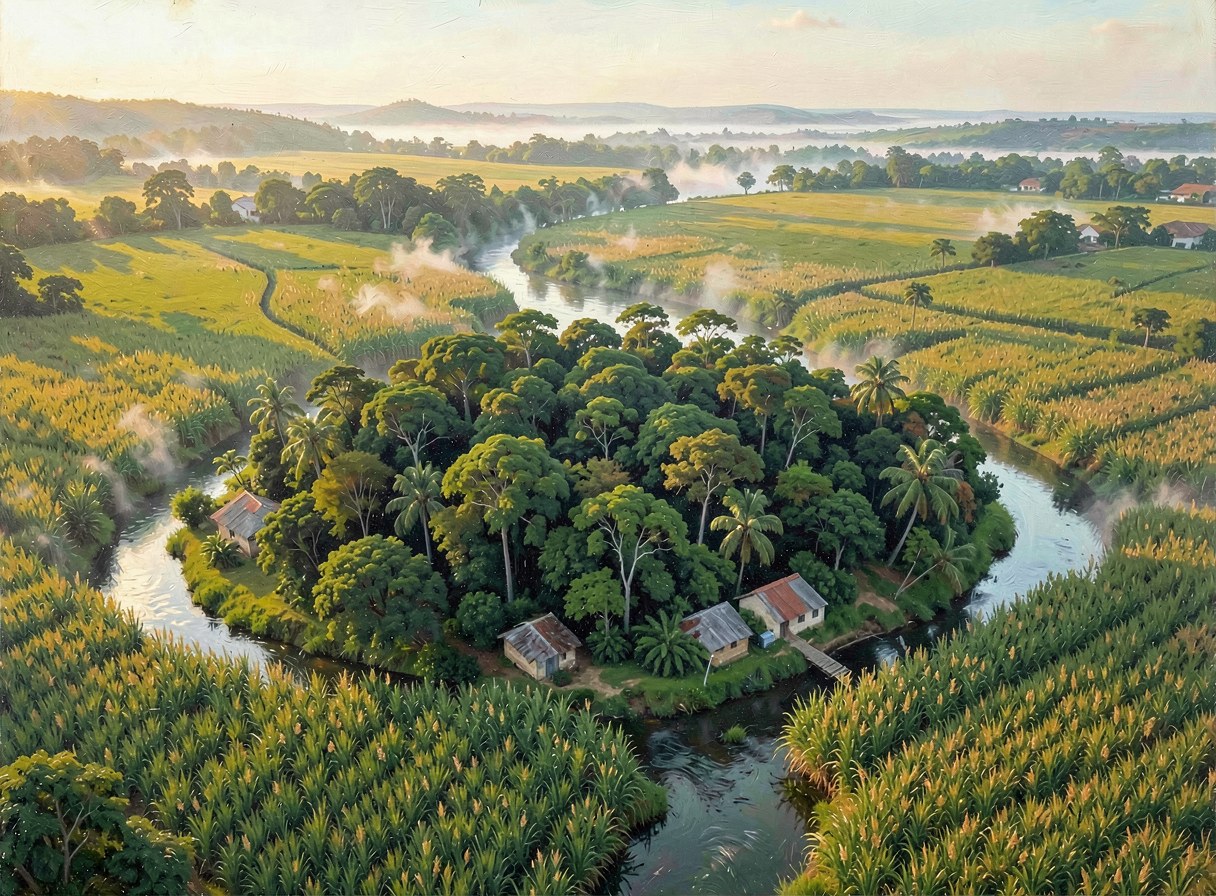
To understand Brazil is to chase a contradiction. It is a nation that holds the roar of Carnival and the whisper of the Amazon, the skyline of São Paulo and the endless Pantanal. It is a land where identity is a mosaic, piece by piece placed by the diverse hands of its people. And sometimes, the most profound piece of that mosaic is not found in a sprawling metropolis or a famous landmark, but in a preserved forest just two hectares wide, in the quiet municipality of Feira Grande, Alagoas. Here, at a longitude that unfurls toward the Atlantic, lives the Tingui-Botó people, a community whose story is a testament to the quiet, stubborn, and beautiful persistence of culture.
Their name might not appear in guidebooks. Their location—defined by the simple fact of their longitude—places them in the Brazilian Northeast, a region often painted with broad strokes of drought and resilience. But to reduce them to a coordinate is to miss the point entirely. The story of the Tingui-Botó is not one of geographic isolation, but of cultural preservation in the face of incredible odds. It is a story that begins not with arrival, but with a label.
For generations, their community was known as “caboclos,” a term often used loosely to describe people of mixed Indigenous and European ancestry, a label that effectively erased a deeper, distinct identity. It wasn’t until the early 1980s that a crucial recognition came. The Brazilian government, through its Indigenous affairs agency (FUNAI), formally acknowledged their identity as a people. This wasn’t the end of their journey, but a new beginning—a reclaimed chapter in a story they had always known they were writing. This official recognition was a catalyst, allowing them to step forward and say, “We are here. This is who we are.”
Central to that identity is a secret: the ritual of the Ouricuri. Nestled within their carefully protected two-hectare forest reserve lies the sacred ground for this ceremony. Details are closely guarded, shared only among the community, as is their right. This secrecy is not an act of exclusion, but an act of profound protection. In a world that so often demands the commodification and display of culture, the Tingui-Botó practice a powerful sovereignty. They decide what is shared and what remains theirs alone. The Ouricuri forest is their heart, a living, breathing repository of memory and spirituality, reminding everyone that the most vibrant culture is often the one that lives most freely.
This deep connection to land and ritual does not exist in a vacuum. The Tingui-Botó’s story is woven into the larger, complex tapestry of modern Brazil. The sources of conflict they face read like a checklist of challenges confronting Indigenous communities worldwide: the pressure of agroindustry and monocultures, the use of pesticides that threaten both land and health, the slow, bureaucratic struggles for the demarcation of traditional territories, and the resulting threats to food security and quality of life. Their battle is not just for cultural preservation, but for the very space and health needed to practice that culture. It is a fight for the air they breathe, the water they drink, and the soil that nurtures them.
Yet, even within this struggle, the narrative bends toward resilience. The Tingui-Botó are not passive victims of history. They are active agents in their own future. Their population, documented at around 469 individuals, represents a community that is present, growing, and insisting on its continuity. Each child who learns the ways of their ancestors, each person who defends their land, is a stitch in the fabric of their future. Their resistance is a creative act—a refusal to disappear, a commitment to evolve on their own terms.
Their existence challenges a common misconception: that Indigenous life is a relic of the past, frozen in time. The Tingui-Botó are simultaneously ancient and modern. They navigate the realities of contemporary Alagoas while safeguarding traditions that connect them to a lineage stretching back centuries. They are a bridge between worlds, demonstrating that cultural identity is not about choosing between the old and the new, but about building a vessel strong enough to carry the wisdom of the past into the waters of the future.
When we zoom out from this two-hectare forest, we see a reflection of Brazil itself. The nation’s official motto, “Ordem e Progresso” (Order and Progress), often feels like an incomplete equation. The Tingui-Botó remind us of the missing variable: Roots. True, sustainable progress cannot be built on the forgetting of who we are. The richness of Brazil—its music, its soul, its bewildering beauty—flows from communities like this one, from the quilombolas, the riverine peoples, the forest guardians. They are the guardians of a diversity that is Brazil’s truest strength.
So, what can a world obsessed with scale and spectacle learn from a people whose most sacred treasure is a hidden forest? Perhaps the lesson is that strength does not always shout. Sometimes, it whispers. It grows quietly, like a root system underground, anchoring a community against the winds of change. It exists in the courage to name yourself, in the wisdom to protect your secrets, and in the relentless hope that your children will inherit not just the land, but the stories it holds.
The Tingui-Botó’s longitude is more than a point on a map. It is a starting point for a conversation about memory, resilience, and the true meaning of progress. As we look toward a future that promises even greater connectivity and change, we must ask ourselves: Are we building a world that has space for all its stories? Can we see the strength in the small, the profound in the protected, and the future in the forests we choose to keep alive? The quiet pulse of Feira Grande suggests that the answer, for those willing to listen, is a resounding yes.