


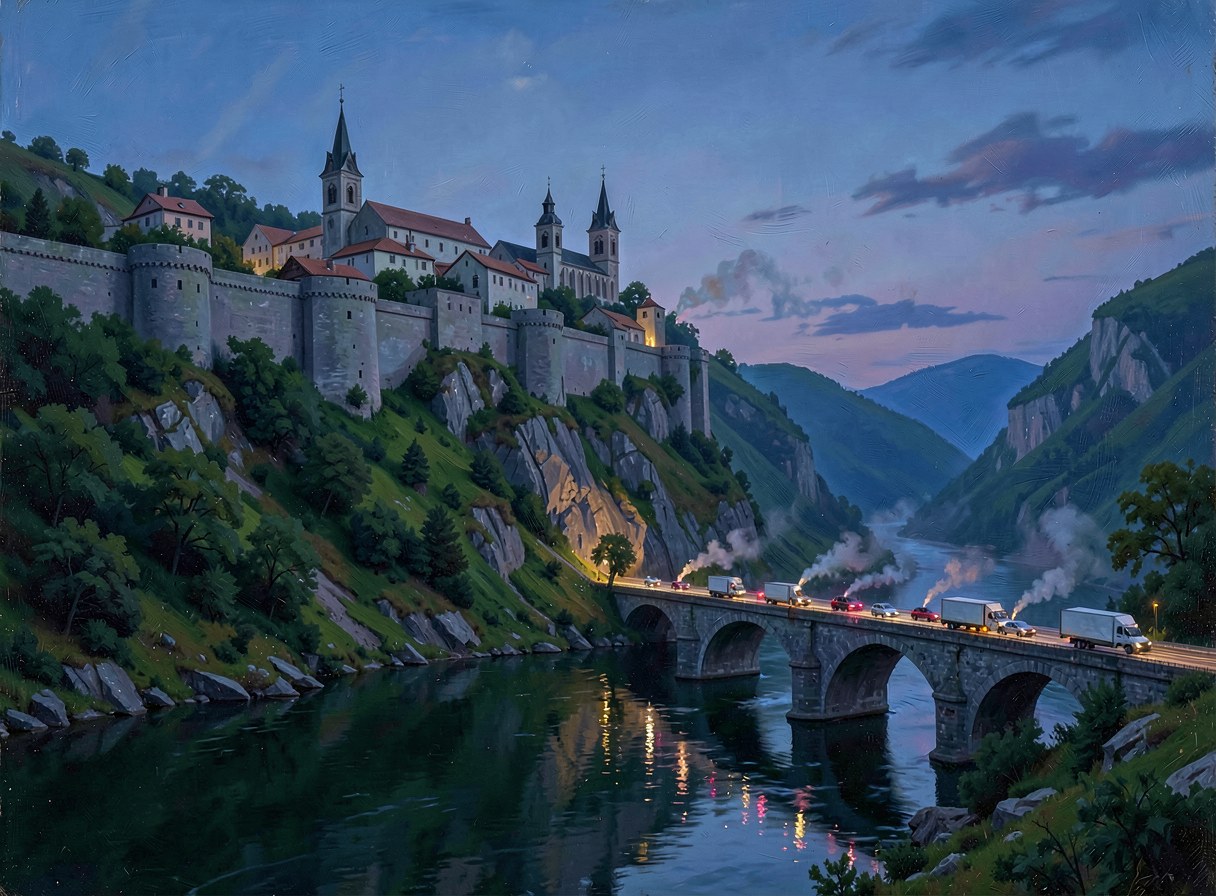
A Tiny Country With an Outsized Shadow
Picture a country so small you could drive across it in under an hour. Its entire landmass fits comfortably inside the state of Rhode Island. It has fewer residents than the city of Amsterdam. And yet, in 2024, this pocket-sized nation recorded one of the most striking environmental statistics in all of Europe: 10.557 tonnes of carbon dioxide emitted per person per year.
Welcome to Luxembourg — the Grand Duchy that punches far above its weight in wealth, diplomacy, and, somewhat inconveniently, greenhouse gas emissions.
At first glance, the number seems almost implausible. How can a country of rolling green hills, fairy-tale castles, and medieval fortresses — a place that markets itself on artisanal cheese, handcrafted pasta, and deep connections to the land — produce more CO₂ per citizen than industrial powerhouses like Germany, which comes in at roughly 6.94 tonnes per capita? The answer lies not in smokestacks and factory floors, but in a fascinating tangle of economics, demographics, geography, and the peculiar mathematics of dividing emissions by a very small population.

The Denominator Problem
To understand Luxembourg’s carbon footprint, you first have to understand Luxembourg itself. The country covers just 2,586 square kilometres, making it the seventh-smallest nation in Europe. Its population hovers around 694,000 — smaller than many individual cities on the continent. This tiny denominator is the first and perhaps most important piece of the puzzle.
Per capita emissions are, at their core, a simple fraction: total emissions divided by total population. When the denominator is small, even modest absolute emissions produce outsized per-person figures. Luxembourg’s total national CO₂ output is estimated at roughly 7.3 million tonnes — a significant number for a country its size, but hardly a global heavyweight in absolute terms. Spread that across fewer than 700,000 people, however, and suddenly each citizen appears to carry a carbon backpack nearly twice as heavy as the average German’s.
But the denominator problem goes deeper than simple arithmetic. Luxembourg’s population is uniquely unusual in composition. Nearly half of all residents are foreign nationals, drawn by the country’s extraordinary economic dynamism and its position as one of the world’s wealthiest nations by GDP per capita. Beyond the resident population, an estimated 200,000 or more cross-border commuters pour into the country every weekday from Belgium, France, and Germany. They work in Luxembourg’s offices, banks, and institutions — generating economic activity and associated emissions — but they sleep in neighbouring countries. Their carbon contributions are counted in Luxembourg’s totals, but they never appear in the population figures used to calculate per capita rates. It is as if a restaurant counted the electricity used to serve 300 customers but divided the bill among only the 150 people who lived upstairs.
Where the Emissions Actually Come from
Sector-by-sector analysis reveals that no single villain is responsible for Luxembourg’s carbon profile. The largest share — about 33.6 percent — comes from electricity and heat generation, a category that reflects the country’s energy infrastructure and its reliance on imported and domestically produced power. Transportation accounts for roughly 14.3 percent, a figure that makes intuitive sense when you consider the daily flood of commuter vehicles crossing three national borders. Manufacturing and construction contribute around 12.2 percent, while buildings — both residential and commercial — add another 6.3 percent.
What emerges is not a story of one dirty industry dragging down an otherwise clean economy, but rather a portrait of a highly developed, service-oriented nation where emissions are distributed across every facet of modern life. Luxembourg’s financial sector, one of the largest in Europe, may not produce visible plumes of smoke, but the data centres, trading floors, and global supply chains it sustains all carry embedded carbon costs that are difficult to disentangle from the national total.
Then there is the tourism and events multiplier. Each summer, the historic Schueberfouer fair transforms Luxembourg City’s Glacis square into a sprawling amusement park that draws roughly two million visitors over three weeks — nearly three times the country’s entire resident population. Hotels fill, restaurants hum, and transport networks strain under the load. While the precise carbon impact of this single event is difficult to isolate, it illustrates a broader truth: Luxembourg’s emissions are not solely the product of its residents. They are amplified by the flows of people and capital that pass through its borders every day.

The European Context — and the Global One
Within the European Union, Luxembourg’s 10.557 tonnes per capita earns it the unenviable distinction of being the bloc’s highest per-capita emitter. Germany, the EU’s largest economy and a country with a far more diversified industrial base, sits at 6.94 tonnes. Slovenia, a nation of comparable geographic size, records 6.27 tonnes. Even Israel, with its own complex energy landscape, comes in at 5.78 tonnes.
Zoom out to the global stage, however, and the picture shifts. The United Arab Emirates, fuelled by hydrocarbon wealth and a desert climate that demands enormous energy for cooling, registers 18.26 tonnes per capita — nearly double Luxembourg’s figure. At the other end of the spectrum, small island nations like Samoa emit just 1.60 tonnes per person, a reminder that development status, geography, and economic structure all shape a country’s carbon story in profound ways.
Luxembourg, in other words, is neither the world’s worst offender nor an innocent bystander. It occupies a complicated middle ground — a hyper-developed microstate whose wealth, connectivity, and small population conspire to produce a per capita figure that looks alarming in isolation but tells a more nuanced story when examined closely.
Signs of Progress Amid the Challenge
The picture is not entirely bleak. Luxembourg has been steadily deploying photovoltaic capacity in recent years, and the growth in solar energy installations has contributed to measurable reductions in energy-sector emissions between 2020 and 2024. The country’s organic and sustainable agriculture sector, while still small, reflects a genuine cultural commitment to environmental stewardship that extends beyond policy into the daily lives of producers, winegrowers, and artisans who shape the nation’s identity.
The Grand Duchy has also positioned itself as a laboratory for sustainable mobility, investing in free public transport — a policy it introduced nationwide in 2020, making it the first country in the world to abolish fares on buses, trams, and trains. The ambition is clear: if you make it effortless to leave the car at home, behaviour will eventually follow.
These efforts matter, but they exist in tension with the structural forces that drive Luxembourg’s high per capita emissions. A country that derives its prosperity from financial services, cross-border commerce, and international institutions will always generate carbon costs that are difficult to reduce through domestic policy alone. The challenge is not merely technological — it is systemic.

What a Small Country Can Teach a Big World
Luxembourg’s carbon paradox offers a lesson that extends far beyond its borders. Per capita statistics are powerful tools, but they are also blunt ones. They flatten complexity into a single number, obscuring the flows of people, capital, and energy that define modern economies. A country’s carbon footprint is not just a measure of what its citizens consume — it is a reflection of the role that country plays in the wider world.
For Luxembourg, that role is outsized. It is a crossroads, a hub, a place where three countries meet and their economies intertwine. Its emissions are, in a very real sense, shared emissions — produced by a community that extends well beyond the lines on a map.
As the world grapples with the urgent need to decarbonise, the question is not simply how to bring Luxembourg’s number down from 10.557 tonnes. The deeper question is this: in an interconnected world where people, goods, and energy cross borders every minute, how do we fairly assign responsibility for the carbon we collectively produce — and how do we build systems that make it possible for even the smallest, busiest, most cosmopolitan places on Earth to thrive without warming the planet?


