


This article is a kind contribution to the blog by Alessandro Burgognoni.
Ethics has always been a subject of study and debate in the human sphere, but today attention is also turning to the intelligent systems made available by modern technology, which are now able to act autonomously and in sophisticated ways, capable of formulating solutions and carrying out the resulting actions, and of expressing “judgments” even in critical areas of real life.
In the human sphere, in a 2014 article, “Ethics and Responsibility in the Post-Human Era,” Prof. Giuseppe Longo (computer scientist, cyberneticist, information theorist, epistemologist, science communicator, writer… the range of expertise is impressive) concluded as follows: “…In conclusion, to improve on their current state while giving the best of themselves, human beings should be willing to re-create themselves on the basis of free relationships with others, of giving and of mutual generosity. But even before that, they should carry out a serious critique of science, technology and economic, health, demographic and development policies.
And even before that, they should regain a sense of responsibility for their own actions: but this recovery is arduous, because individual responsibility gets lost in the thousand rivulets of collective responsibility, which involves no one and is subject to inexorable economic and social conditioning, and to the almost automatic and certainly undemocratic advance of technology.
This collective responsibility, distant and diluted, weakened even further by globalization, is so reassuring that it makes us forget that part of that responsibility falls on each of us: but who has the strength, the courage and the clarity to shoulder it?”
Responsibility, as Prof. Longo argues, falls on each of us and on our ability to look beyond our small, well-defined everyday world.
Shifting attention toward self-promotion, in an extremely competitive world, pushes away our sense of responsibility toward the world and replaces it with actions aimed at promoting our own image, in order to be included, or at least not to be or feel excluded from the “winning” reality. Meanwhile, this self-promotion and its amplification clash with another vision of the world which, as Longo argues, would lead human beings “…to re-create themselves on the basis of free relationships with others, of giving and of mutual generosity,” in spite of a collective responsibility that seems to involve everyone and no one.
Decisions and the responsibilities that follow from them ought to be dictated by objective criteria, but in the end reality is very different from theory. This has long been known in the human sphere: many have carried out in-depth analyses of human error and of ways to avoid it, or more often of how to limit the damage of a wrong decision in an operational context.
Decisions within a specific field are affected by various conditions linked to stress, experience, membership of a social group, culture, state of mind, and misinterpretations of the facts, situations and phenomena of the reality one lives in and observes.
A case in point is the experiment put to a group of judges: to assess the sentence for a hypothetical offense, with the documentation on the case at their disposal; the resulting sentences were highly inconsistent, at times completely opposite in terms of severity.
All this concerns us, but it is reflected in the offspring of our intelligence, in the machines that must take actions and make decisions in the real world in our place.
The philosopher Hans Jonas suggests going to the philosophical roots of the problem of responsibility, which involves not only the issues and choices needed for the survival of the human species, but all the issues linked to everyday life and to the different ways in which that existence unfolds. Jonas makes us reflect on the need to be aware of our present in view of our future, a responsibility that falls on every human being, and with particular weight on those who play a decision-making role in matters of common interest, with a view to what we leave to those who come after us in terms of the possibilities and quality of existence.
Along the lines of this vision of responsibility and of the related human ethics, the issue of the ethics of “intelligent” machines proves timely: machines that are increasingly independent and governed by ever more effective algorithms, but algorithms nonetheless. Who governs the rules by which they are applied? Who decides whether their effectiveness and operation are fitting for “the human”? It therefore makes sense to ask questions about “machine ethics,” a subject that has long been in vogue, ever since computers began to be not only processors/manipulators of symbols but also, through their interfaces with the world, executors of concrete actions.
An article by the Italian philosopher Luciano Floridi, a keen scholar of the subject, analyzes the relationship between agents and patients (Editor’s note, from Wikipedia: Agent: an entity that voluntarily performs an action, and is therefore intentionally an active part of the event. Patient: an entity passively involved in the event set in motion by an agent (it suffers the consequences or finds itself in a certain condition)) in terms of how ethical theories (macroethics) study the relationship, the logical relation, between the one who acts and the one who receives an act; he has also devoted a book specifically to setting out his views on the ethics of artificial intelligence.
Floridi introduces the concept of the separation between intelligence and action: machines act in an apparently intelligent way but emulate human behavior without being conscious of it. If the goal is to obtain a meaningful action, the machine will carry it out according to the directives imposed or declared, or those derived from the conclusions that the algorithmic pyramid controlling it is able to generate. In essence, today we have separated the ability to act from intelligence, which creates ethical problems at various levels.
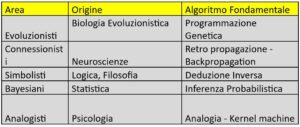
Today there are advocates of an algorithmics capable of going beyond advanced data analysis, predictive analytics and the extraction of tacit knowledge. Among them is Pedro Domingos: in his book “The Master Algorithm,” the author, a professor at the University of Washington, hopes for the creation of an advanced algorithm that would be the synthesis of the existing logics/methods in the field of algorithmics, able to “tackle” every sort of problem in a way similar to the human approach but more efficiently: a learning system capable of “inferring” from tacit knowledge in order to provide answers and solutions hidden in the world’s new oil, data, drawing on all the tools the various approaches offer and making them work together, each sharing with the others what it can glean from data or from manipulating or classifying it.
The following table presents the five areas of study that would converge in the “super-algorithm”:
Domingos initially takes an apparently balanced approach compared with one that would hand machines total algorithmic control of processes; see the following statement given in an interview: “…But it’s not so much that machine learning will be superior to our brain, but that our brain extended with machine learning will be superior to our brain without it” (Pedro Domingos interviewed in 2015 by Gregory Piatetsky).
In essence, intelligent systems that complement our abilities, collaborators and explorers of the infinity of knowledge present in data and in its manipulation, but not
artificial subjects to which we delegate the destiny of our lives entirely.
On the other hand, in a 2015 article Domingos looked beyond his earlier hypothesis, proposing a future in which a “digital entity” becomes real: an agent that represents us in
everyday life, working for us and better than us in our daily actions, interacting with other digital counterparts that will represent people, companies, organizations and active subjects in a digitized world,
negotiating and selecting for us items such as insurance, contracts, bank accounts, services, etc.
An agent that will represent us because it is built on our habits, on our data, on our
digital life and on the actions and choices we have made over time: a digital alter ego, a sort of functional avatar so efficient that it can support us and stand in for us when necessary in a
digital world that has become too fast for us and perhaps, in some respects, incomprehensible.
Giving meaning to our research, and not being dazzled by the race for applications that can be introduced without asking about the consequences of what we build: this is the difficult path to keep to in a competitive regime where AI is now on a multi-lane highway with no speed limits, where new solutions and applications arrive day after day.
Some argue that expectations are excessive compared with reality and that AI marketing will lead us into a new bubble, as has happened in the past. In my opinion, while some expectations are exaggerated (see the line of research into the possibility of “conscious machines” or of systems with AGI, Artificial General Intelligence, which posits the ability of an intelligent agent to understand and learn any intellectual task proper to a human being), the technological situation is very different from the past, and the basic tools on which to build technologies with intelligent “behavior” are today fully present and evident in what has been achieved.
Today’s wise minds, in fact, including Margaret Boden, argue that the problem is not so much what intelligent systems can do as what we want to make them do, and these are two very different orientations.
The road has long been open, and now that we have the tools to travel it we do so at high speed, proud of our means and our intelligence; but this is not enough to make us
able to predict our future and the consequences of today’s actions on tomorrow’s conditions.
On the question of whether a conscious machine could be built, the position of Federico Faggin, who at Intel invented the first microprocessor, the “4004,” is illuminating. Alongside his many technological creations, he has made
an extraordinary journey in renewing the approach to the study of consciousness, concluding to date that no machine can be conscious. From his personal website, an excerpt from the essay “What Is Awareness?”:
“…Consciousness allows us to do much more than act blindly with an automatic response to sensory signals, which is all a machine can do. By smelling the scent, seeing
the image and touching the petals of the jasmine, we connect with that flower in a special way.
We “experience” the jasmine. This lived experience goes far beyond the mechanical recognition of an object. A machine, on the other hand, cannot connect with anything, because it is only a web of
blind actions and reactions.
At this point consciousness could be defined simply as the capacity to feel. But feeling implies the existence of a subject who feels, an observer, a self. Therefore,
consciousness is inextricably linked to a self. Self and consciousness are inseparable.
We could then say that consciousness is the intrinsic capacity of a self to perceive and know through a sentient experience. But there is even more, because consciousness can also turn
toward the self, allowing it to know itself in addition to the outside world.”
It follows from the above that if no machine is conscious because it lacks a “Self,” and if behind every working machine there is a human being and their ability to give it rules and operating logic, then the problem of the ethics of intelligent systems shifts to us humans and to our desire to automate the world around us to such a degree as to delegate responsibility for actions and judgments to a chain of sophisticated but unconscious algorithms.
Among the pioneers of advanced human-machine interaction is Weizenbaum, the father of “Eliza,” the first “chatbot” in history. It was so convincing, in fact, that some people thought it was a real therapist of the Rogerian school, whose patient-centered approach, typical of that school of thought, it was meant by design to represent in conversation. Over time its author would try to explain that this apparently intelligent behavior had no intelligence behind it, only programming logic that emulates it.
This gave rise to the “Eliza effect,” the tendency to anthropomorphize a machine and its expressions while interacting with it.
In short, the computer and the program running on it are credited with behaviors equivalent to human behaviors, leading
the person interacting with it to suppose that their interlocutor is endowed with high intelligence.)
Turning our attention to the “quality” of knowledge, we realize how (a very topical issue) cognitive biases, prejudices, personal leanings and opinions are
scattered through the trillions of data points we produce every day with our actions. Whoever supplies the data to a system can select the data according to their own beliefs; there are already cases of
“automatic” résumé screening that produced racist assessments during personnel selection.
Possible countermeasures are found in the new field of algorithmic fairness, a fast-growing area of research that aims to reduce discriminatory effects, especially when algorithms are
used in human evaluation in the various forms of machine learning.
The research area is strongly interdisciplinary and aims to analyze and improve learning models in order to obtain balanced projections or predictions that fall as far as
possible within the bounds of equity and justice. The problem is that there is no exhaustive and universal definition of correctness or equity (fairness)). Both Google (fairness indicators) and IBM (bias mitigation) are heavily committed to this field.)
To conclude this article, in which I have touched only on a few macro aspects of the subject and tried to outline in extreme brevity the issue of the ethics of “intelligent” machines,
we can say that machines capable of judgment and consequent action, of data analysis and of extracting knowledge from enormous volumes of data, are all around us. Ultimately they reflect what we are or what we desire, but because of their complexity they could go beyond our expectations and our wishes and act, or make choices, that are humanly unacceptable, purely on the basis of algorithmic logic and the data made available to them.
Already today we have processes based on deep learning that give coherent solutions whose path to resolution we do not know, because it is locked away in the depths of the network itself. This should signal to us the caution we need in order to get what we want, and push us to build systems for monitoring the intermediate layers
of these problem-solving networks so as to understand their underlying logic thoroughly.
In the final pages of his book “The Master Algorithm,” cited above, Pedro Domingos closes his futuristic reflections with a pithy summary: “People worry that computers will get too smart and take over the world, but the real problem is that they’re too stupid and they’ve already taken over the world.”
Finally, a reasonable philosophical observation that emerges from some comments and opinions online: in the current situation, lacking stable reference values, we should try to understand whether our ancestral and often hidden need to find an absolute point of reference is leading us toward the mirage of building a new algorithm with hypothetical “omniscient” abilities, to restore meaning to existence through a “digital absolute,” someone to whom we can delegate responsibility, power and decisions, with the risk that those who have the means will take over this
mechanism and use it for questionable or oppressive ends.