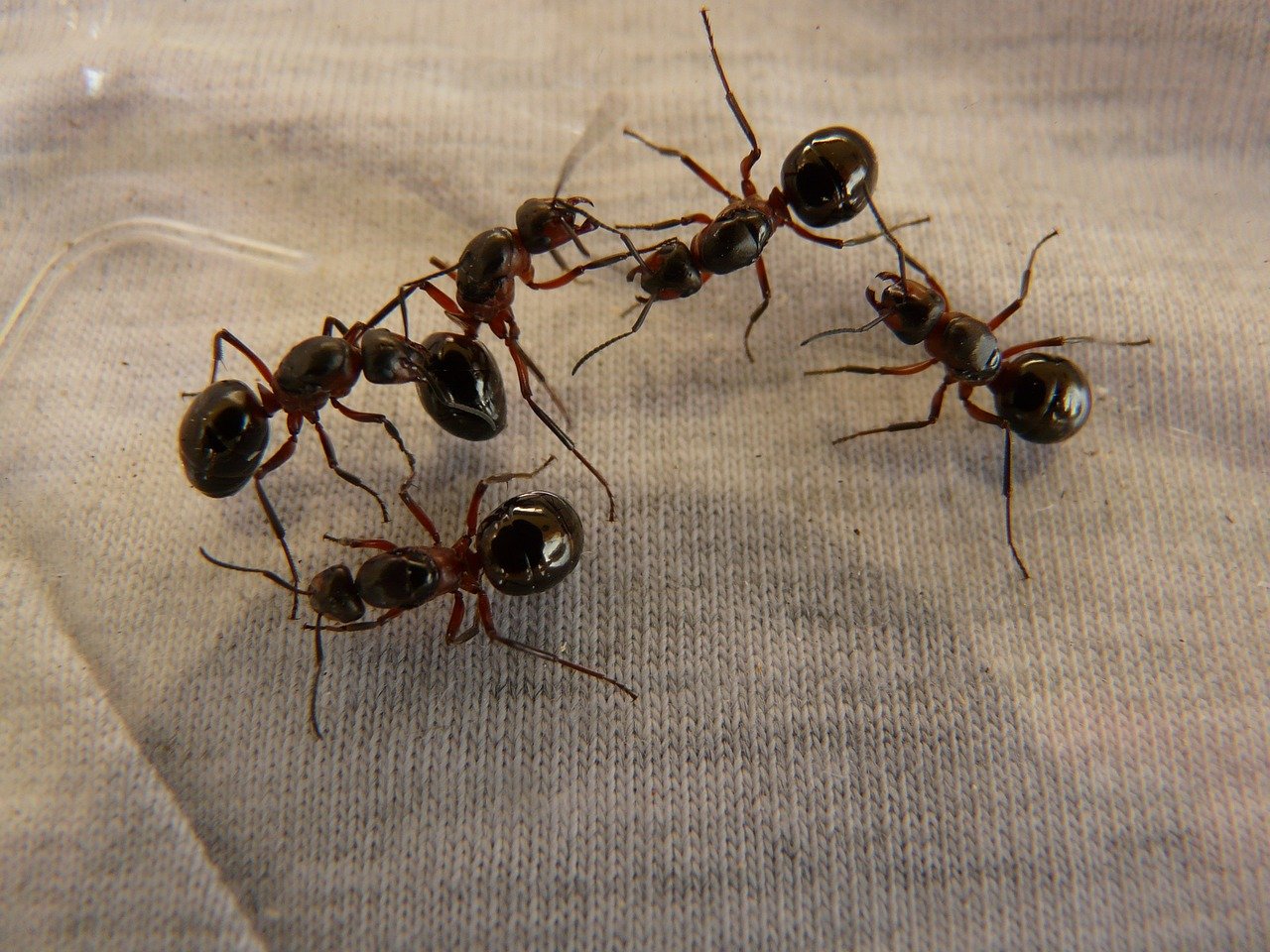
A team led by evolutionary biologist Volker Nehring is studying the extent to which ants learn from past experiences
Ants learn from experience. This has been shown by a team of evolutionary biologists at the University of Freiburg, led by Dr. Volker Nehring, research associate in the Evolutionary Biology and Animal Ecology group, and doctoral student Mélanie Bey. The researchers repeatedly confronted ants with competitors from another nest. The ants tested remembered the negative experiences they had during these encounters: when they met ants from a nest they had previously experienced as aggressive, they behaved more aggressively towards them than towards ants from nests unknown to them. Ants that met members of a nest from which they had previously encountered only passive ants were less aggressive. The biologists published their results in the journal Current Biology.
Ants are aggressive towards their neighbors
Ants use smells to distinguish between members of their own nest and those of other nests. Each nest has its own specific scent. Earlier studies had already shown that ants behave aggressively above all towards their closest neighbors. They are particularly likely to open their mandibles and bite, or spray acid and kill their competitors. They are less likely to carry out such aggressive maneuvers against nests farther from their own. Until now it was unclear why this happened. Nehring’s team has now discovered that ants remember the smell of aggressors. That is why they are more aggressive when confronted with competitors from nests they are familiar with.
More aggressive behavior towards competitors from familiar nests
The scientists carried out a two-phase experiment. In the first phase, the ants gained different experiences: one group met ants from their own nest, the second group met aggressive ants from a rival nest A and the third group met aggressive ants from a rival nest B. A total of five encounters took place on consecutive days, each encounter lasting one minute.
In the following test phase, the researchers examined how the ants from the different groups behaved when they met competitors from nest A. The ants that had already faced conspecifics from this nest in the first phase behaved decidedly more aggressively than those from the other two groups.
To test the extent to which the increased aggression stems from the behavior of the ants of a particular nest, the scientists repeated the experiment in a slightly modified form. In the first phase they now distinguished between encounters with aggressive and passive ants. They made sure an ant behaved passively by cutting off its antennae. In the second phase of the experiment, the ants that had previously met only passive competitors behaved much less aggressively.
Conclusions
“We often have the idea that insects function like pre-programmed robots,” says Nehring. “Our study provides new evidence that, on the contrary, ants too learn from their experiences and can hold a grudge.” Next, Nehring and his team will investigate whether, and to what extent, ants adapt their olfactory receptors to their experiences, thus reflecting what they have learned at this level too.
- Mélanie Bey earned her doctorate with Dr. Volker Nehring. Rebecca Endermann, Christina Raudies and Jonas Steinle are former bachelor’s and master’s students of the Evolutionary Biology and Animal Ecology working group.
- The research was funded by the German Research Foundation (project number NE1969/6-1).