


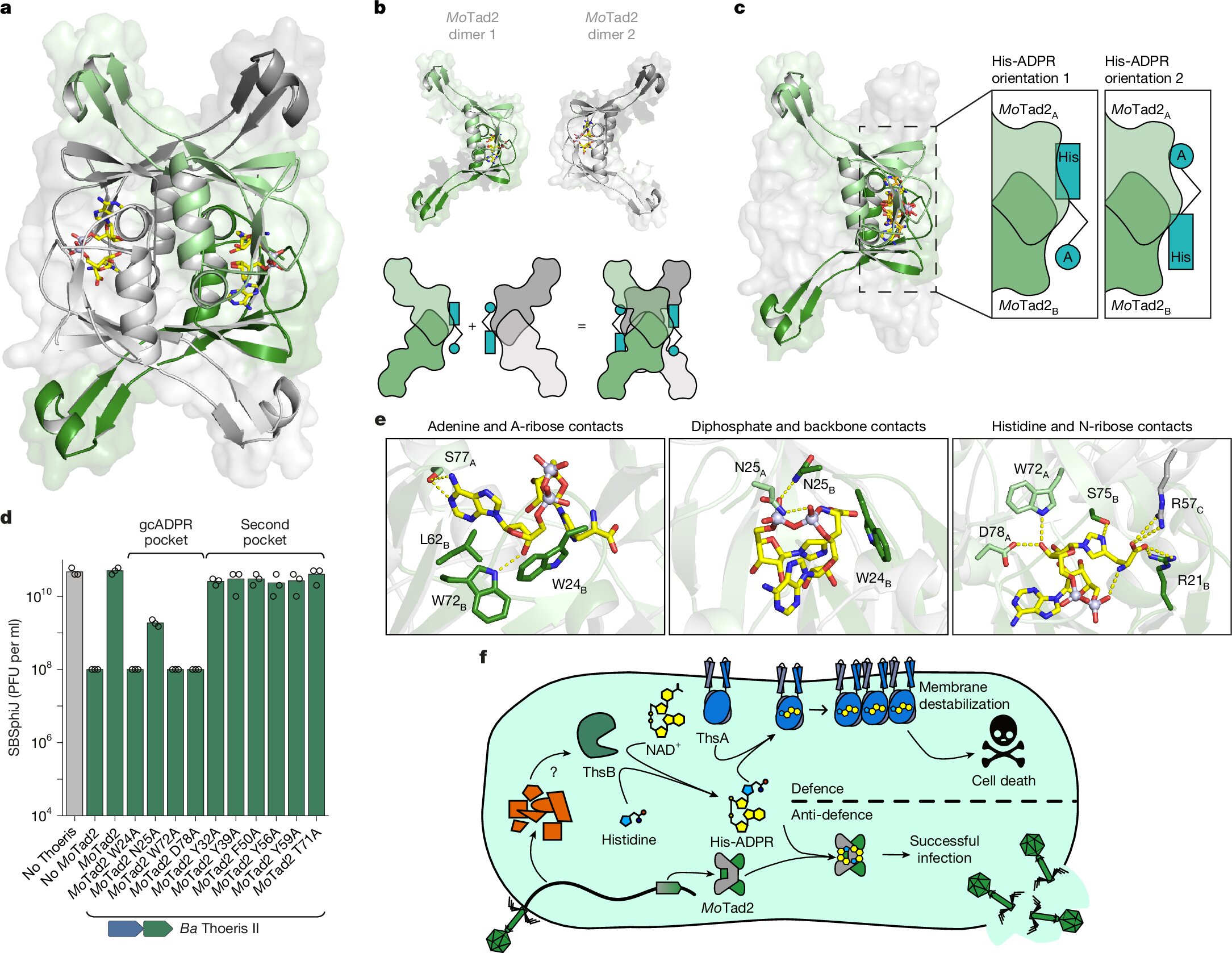

Structural basis of His-ADPR sequestration by MoTad2. Credit: Nature (2025). DOI: 10.1038/s41586-025-08930-2
A research team has discovered a previously unknown type of immune signaling molecule, a new compound combining histidine and ADP-ribose, produced by the bacterial Thoeris II defense system in response to viral infection. This discovery expands our understanding of bacterial immunity and may pave the way for innovative tools in biotechnology, gene editing and antimicrobial therapy.
The paper, titled “TIR domains produce histidine-ADPR as an immune signal in bacteria,” is published in the journal Nature, and the team includes scientists from the Life Sciences Center of Vilnius University (VU LSC), together with colleagues from the Weizmann Institute of Science (Israel) and Harvard Medical School.
The discovery sheds light on how bacteria, just like humans, communicate viral threats at the molecular level, in this case by triggering a self-sacrificing response to stop the virus and protect bacterial populations. Beyond its fundamental significance, the discovery opens exciting avenues for rethinking immune mechanisms and virus-host interactions.
This newly identified molecule is remarkable for its unique structure, linking two biologically essential components: histidine, an amino acid used to build proteins, and an adenine nucleotide, a building block of RNA. Until now, all known signaling molecules were composed exclusively of nucleotides. This discovery significantly broadens scientific understanding of the diversity of immune signaling mechanisms in nature.
Like humans, animals and plants, bacteria are constantly threatened by viruses. Over the course of evolution, they have developed a vast array of defense systems, some of which were the evolutionary precursors of immune system components in higher organisms. Interest in bacterial antiviral systems grew after their applications in genetic engineering were realized. Landmark examples such as restriction-modification systems and the CRISPR-Cas “molecular scissors” have even been recognized with Nobel Prizes.
To date, scientists have identified more than 250 distinct antiviral defense systems in bacteria.

Discoveries like this not only deepen the understanding of bacterial immune strategies, but also lay the groundwork for innovations in genetic engineering, biotechnology and even the development of new antibacterial therapies.
In this latest study, Dr. Tamulaitienė’s group took a close look at the Thoeris II system, composed of a sensor protein (TIR), which detects viruses, and a transmembrane effector protein (Macro), which receives the signal and triggers a response. After detecting viral infection, the TIR sensor synthesizes a unique small-molecule signal: His-ADPR.
“This ‘message’ – the signaling molecule – is recognized by the system’s effector, the Macro protein, which is embedded in the bacterial cell membrane,” explains Dr. Tamulaitienė.
“Once they receive the signal, the Macro proteins begin to assemble with one another, damaging the cell membrane. In this way the infected bacterium sacrifices itself before the virus can replicate, allowing neighboring bacteria to survive and preserving the population.”
Using X-ray crystallography, the VU LSC team determined the structure of the effector protein bound to the new signaling molecule.
Meanwhile, the Weizmann Institute team confirmed that this molecule is indeed synthesized in bacteria upon viral infection. Researchers at Harvard Medical School revealed the structure of a viral “sponge” protein—a countermeasure the virus uses to evade the immune system—with His-ADPR bound inside.
More information:
Giedre Tamulaitiene et al, TIR domains produce histidine-ADPR as an immune signal in bacteria, Nature (2025). DOI: 10.1038/s41586-025-08930-2. www.nature.com/articles/s41586-025-08930-2
Provided by
Vilnius University
Citation: Discovery of histidine-ADP-ribose molecule reveals a new bacterial immune strategy (2025, May 1) retrieved May 1, 2025 from https://phys.org/news/2025-05-discovery-istidine-adp-ribose-molecule.html
This document is subject to copyright. Apart from any fair dealing for the purpose of private study or research, no part may be reproduced without written permission. The content is provided for information purposes only.


